Showing posts with label predators. Show all posts

Thursday, March 7, 2013

Turdus migratorius, American Robin


The robins are here!  For such a pretty and lovable bird, they have a very unflattering scientific name: Turdus migratorius.  The migratorius part isn't so bad, and robins are indeed migratory birds.  But why the name Turdus?  Scientific names are in Latin, and 'turdus' means 'thrush' in Latin, which is a bad deal for the robin.  A thrush is a type of bird that is usually small and plump and searches for food on the ground.  Bluebirds and wood thrushes are other common Middle Tennessee thrushes.
A male robin.
Robins are grayish with rusty undersides.  The males' heads are darker than their backs, and their underbellies are usually brighter than females'.  Last week a male and female were getting to know each other at our outdoor classroom. 
A female robin.
 In Nashville, this time of year robins are just finishing up their winter migration.  Robins group together near the end of winter into massive flocks (did you notice them a couple weeks ago?), then they migrate to follow food sources and warm weather.  They may not migrate straight north like most other migratory birds do - they just go wherever life is good for robins, which explains why we have some robins here year-round.  At the end of the winter migration, birds form pairs and begin to find a home range to nest in.  They may come back to the same place as last year, but they may not.
A female robin between the two Japanese quinces.
Robins are generalists in both nesting and in feeding.  They build nests in a variety of habitats, from landscaped yards to meadows to forests.  They eat a variety of insects, worms and fruits, depending on what is available to them to eat.  In the spring and summer, they tend to eat more insects, and in the fall and winter they eat more fruit and berries.  This time of year, you are likely to see the cliché of a robin with a worm dangling from its beak.  Robins can usually find their food and shelter requirements around where humans live, so they tend to be very familiar to us.
A female foraging for ground insects or worms and a male sitting on the fence.
If the male and female I saw at our outdoor classroom become a pair, they will have 2-3 broods of baby robins this spring and summer.  The female will soon start building a cup-shaped nest of three layers: twigs first then mud then grass on the inside.  She will probably lay 3 light blue oblong eggs in the nest a couple of days after it is finished.  The female sits on the nest for 12-14 days, getting up every once in a while to turn the eggs or go get food.  The male might bring her some food or might not.  The female's belly has a patch of skin with extra blood vessels that keep the eggs warm as she sits on them.  If the eggs get too cold, they will die.  When the eggs hatch, the female tosses the egg shells out of the nest and broods (sits) for another 3-4 days.  After that, the hatchlings are able to keep themselves warm enough without being sat upon constantly.

Both parents feed the hatchlings after they escape their eggshells.  For the first few days, the menu is regurgitated food the parents already ate.  And if that isn't gross enough, after that the parents bring soft-bodied insects and worms to feed the poor little birds.  The hatchlings beg and peep like mad for their food, so they must like it.  Begging is an important skill for robin hatchlings, because the most aggressive peeper with the longest neck and widest-open beak will get the most food and is most likely to survive to adulthood. 

At two weeks old, the robins usually fledge (leave the nest).  They still don't fly well or know how to find food, so the parents hop around them on the ground alerting them to danger and bringing them insects and berries.  At first, the mom feeds the fledglings, but then when they are starting to become independent, the dad will feed them, and the mom will go and build a new nest for the next brood.  The fledgeling stage is very dangerous for the birds because the young ones can't fly yet.  They might become the food that a mother hawk brings home to her hatchlings, or they might fall prey to a cat.

There are many types of birds at our outdoor classroom right now.  Next time you go, try to count the different types of birds you see.  Last time I was there, I saw 3 kinds.  Pay special attention to the robins, and see if you can figure out what they are doing when you see them (feeding? gathering nest materials? searching for a good nest site? fighting off other birds? or are they watching you?).   

Friday, February 22, 2013

Secrets in Sedementary Rocks

[This is a follow-up post to the first Geology post from a few weeks ago.] 

These rocks need names.  Each of the big limestone boulders in the circle in our outdoor classroom has something unique to offer the curious eye.  I'm sure by now most students have decided which rock is their favorite to sit on when they visit the outdoor classroom.  For now, I'll number the rocks 1-8, but hopefully students will come up with actual names for them. 
Rocks 1-4, left to right in the picture.
If you follow the main path into the circle, rock number one is on the left.  Then continue counting around the circle.  The fence is between 4 and 5.  Rocks 7 and 8 are the last ones, and they have been placed right next to each other.

Stand in the center of the circle and look around at the rocks.  What are the first things you see?  I see scrape marks, those lighter marks on the rocks where some serious equipment carried them from somewhere else in TN to here.  Next I notice that the rocks look layered.  These rocks are sedimentary rocks, formed over thousands of years as water dropped off layer after layer of tiny mineral particles (more below).

Let's take a look at a few specific rocks in more detail and see what they have to tell us.

Rock #1:
Most of the rock does not contain visible fossils, but there is a gigantic nautiloid fossil that is fairly easy to locate on the surface of the rock.  Hard structures of ancient creatures formed fossils easily, and nautiloids had hard, segmented structures that left fossils like the one to the right of my finger below.  Nautiloids were predators, and where there are predators, we know there has to be prey.  Nautiloids' prey organisms were soft-bodied, so they didn't tend to leave fossils.  The amount of rock that contains a nautiloid is small compared to the rest of the rock because nautiloids were fairly rare in their ecosystem.
Rock # 2:
This rock has a fossil from an organism called a bryozoan.  Bryozoans are filter feeding animals that live in colonies.  They are much like corals, though they are not closely related to corals.  It's common for organisms to be similar and yet unrelated.  For example, penguins and dolphins have many similarities (shape, color, swimming style), yet they are very different types of organisms: penguins are birds and dolphins are mammals.  In the same way, bryozoans and corals are similar in shape and habit yet unrelated.  Bryozoans were much more common when these rocks were formed (300-500 million years ago!) than corals were, and there are several bryozoan fossils on our rocks.
T-shaped Bryozoan fossil on Rock 2.
Rock 3:
Find the crystal-lined hole in Rock 3.  You have found a geode-like structure.  Geodes can form in different ways, but it is likely that this one formed when part of the original sedimentary rock dissolved and washed away to leave a hole, or cavity.  Then over thousands of years, water seeped through the cavity.  Water usually has dissolved minerals in it, and sometimes those dissolved minerals crystallize into solid minerals.  If you have an older faucet at home, look for a whitish crust around it - the white crust is crystallized minerals from the water that is carried through the pipes.  I suppose if the conditions were right your faucet could be covered with pretty crystals in a few thousand years as more and more minerals are deposited on it.  The same process that makes the crust on your faucet made the geode you see in this rock.
A geode-like cavity in Rock 3.
Rock 7:
Rock 7 is my favorite for looking at the layers of sediment that formed the rock.  For some reason, this rock was placed on its side, so the layers are more easily visible.  Flowing water makes sedimentary rocks.  Fast-moving water picks up larger, sand-sized sediment and carries it until the water slows down.  Then the sediment falls out of the water and settles on the ground in a flat layer.  Slower-moving water picks up smaller particles, like the particles that make up mud.  When slow water stops moving, it drops its particles onto the ground.  If the speed of the water above the ground changes through the decades, the sediments that settle onto the ground will have different textures.  The darker, smoother bands in Rock 7 were formed from slow-moving water's particles.  The lighter, rougher bands were formed from faster water's particles.
Layers in this sedimentary limestone reveal the speed of the water that deposited the particles.
There are lots more treasures to find on these rocks, so look carefully.  There are many more fossils, interesting rock layers, geode-like structures and other strange features.  I would like to thank Mr. Smail for teaching me about our rocks.  Feel free to email him if you have more Geology questions!


Thursday, August 16, 2012

Invasion of the Blue Dasher Dragonflies

Blue dasher dragonfly.  Are those aviator sunglasses?
The outdoor classroom and back field of our school has been a-buzz with these miniature blue helicopter-like insects.  They are a type of dragonfly called blue dashers (scientific name Pachydiplax longipennis, which means double-thick long wings, by the way), and they are beautiful!  The one above is an adult male, which you can tell from the bluish color of his abdomen.  Females and young adult males have brownish-black abdomens.  Both males and females have brown and yellow wavy stripes on their mid-section, or thorax.  Blue dashers all have a white head with bluish-green eyes.  In the picture above, the white patch on the head is the upper and lower mandible, which the dragonfly uses to bite its prey.

Dragonfly eyes are amazing.  They cover most of the head and provide the dragonfly with a 360 degree view of their world.  Dragonflies need excellent vision of their surroundings because they can fly and maneuver so quickly.  If they couldn't see in all directions, they'd constantly be smashing into things.  Dragonflies fly quickly because they need to catch their prey, which consists of insects that can also fly.  Blue dashers specialize in mosquitoes, gnats and flies, but they also eat butterflies and grasshoppers.  

Blue dasher demonstrating its helicopter shape, with a long abdomen to balance the head.
Since dragonflies are so big and fast, sometimes people are afraid of them.  The good news is that dragonflies are harmless to humans.  They do not bite or attack humans, and the long, pointy abdomen does not sting.  The shape of the abdomen serves as a counter-weight to the head, keeping the body of the insect level as it is suspended by its wings in flight.  If you look at the picture above, you can see how the head and tail appear to balance each other out under the wings.  Blue dashers are particularly useful on the school grounds because they keep other biting insects away from the kids' outdoor areas.

All dragonflies lay their eggs in water, and we probably have blue dasher nymphs in our pond at school.  After being deposited in the water, dragonfly eggs hatch into nymphs (underwater larvae), which grow and eat other aquatic insects and tiny fish until they are big enough to metamorphose into adults.  When a dragonfly becomes an adult, it crawls out of the water onto a stem or rock, splits its exoskeleton, and drags itself out of the shed skin as a fully-formed adult.  Blue dasher nymphs are particularly tolerant of poor water conditions, which makes them ideal for living in an urban environment.  They are widespread around the United States and in southern Canada in all variety of habitats. 
Dragonfly nymph exoskeleton. (Photo: Mary Entrekin Agee)

Thursday, June 21, 2012

Rethinking the Canada Goose

Don't say Canadian - it's Canada.  The Canada goose (Branta canadensis) is a common sight in Lincoln Park, and I got to know their behaviors a little better as I watched them raise their young this spring.  Despite what some people say, they're really quite enjoyable neighbors.

Canada geese pair and young in Lincoln Park.
The geese started hatching in early May this year, and within a day or two, they were out of the nest walking and swimming and finding food.  Adult geese mate for life, with the average goose living around 24 years of age in the wild.  They tend and defend their young, but they do not feed them.  The goslings feed themselves as soon as they are out of the nest. 
Dabbling geese with a duck observing them, probably finding their upended tails completely hilarious.
Geese eat muck from the bottom of ponds, as you can see them doing in the photo above.  The tails-up bobbing for scum is called dabbling, and it never fails to crack me up.  Geese also eat grass, grains, berries and other plants, with the occasional bug thrown in.  Herbivores in general must eat a lot more volume of food to survive, and geese seem to eat constantly.  Such a large volume of food results in respectable quantities of goose poop, which people sometimes find annoying.  Admittedly, there are some beach areas in the US with hundreds of Canada geese where I would not want to walk barefoot or swim, but these are not the norm.  A little bit of goose poop is certainly better than a little bit of dog poop, since carnivore poop usually contains more harmful disease bacteria than herbivore poop.

Many of the geese in Lincoln Park probably flew north to Chicago earlier in the spring from the southern US or Mexico.  More Canada geese are migratory than non-migratory, though some members of the species have begun to live in the same location year-round.  The newer, non-migratory geese are an evolutionary response to the recent changes in their habitat: in the past 100 years, permanent open grassy areas with maintained, predator-free ponds have appeared everywhere.  Indeed, golf courses, airports, office complexes and neighborhoods provide goose heaven, and Canada geese have increased their numbers in response.  Once a fairly rare species, the Canada goose has become common enough to annoy annoyable people, sometimes even being called a pest.

In Lincoln Park, people mostly seem to enjoy the geese.  They watch them, photograph them and feed them, despite signs forbidding the feeding of wildlife.  The goslings provide food for the black-crowned night herons, and the geese eat excess pond vegetation.  Canada goose behaviors are fairly simple and easy to observe, so lots of kids and adults learn about bird biology by observing geese.  Unfortunately, geese seem to be such a common sight that some people have lost their respect for the geese's size and strength.  Parents let their toddlers chase the geese and approach the young, even with the parent geese hissing and ready to bite (yes, they lunge, flap, bite and cause an unnerving ruckus in self-defense).
A wood duck (left) hanging out with Canada gees (right) at the Alfred Caldwell Lily Pond in Lincoln Park.
Where Canada geese are a considered a nuisance, wildlife management personnel have responded with extended hunting seasons, attack dogs, culling of adult birds and donation to food charities, collection of eggs for human consumption (I hear they are delicious) and addling of goose eggs.  Addling is a technical term that means preventing an egg from developing without destroying the egg, by shaking or coating with oil to prevent oxygen from diffusing into the egg.  Goose eggs are addled instead of being simply taken because the geese can lay a second clutch of eggs.  Canada geese, like most animals, are regulated.  Geese are regulated by the Migratory Bird Act, so before someone dabbles in addling, they must apply for a permit.  An easier humane solution to overpopulation of geese would be to modify habitat to make it less inviting.  Geese will not nest in an area without good sight-lines for detecting predators, so smaller patches of lawn interspersed with shrubs or potential predator hiding places will deter them.  If we take a little time to appreciate and get to know Canada geese, they seem much less like nuisances and much more like fascinating clowns of the bird variety.


Thursday, May 3, 2012

Black Crowned Night Herons in Lincoln Park


There is a surprising diversity of animal life in Lincoln Park, and that's not even counting the zoo animals.  The latest residents of the park are what appears to be dozens to several hundred nesting black crowned night herons.    The two lumps in this picture are black crowned night herons.  Don't see lumps?  There's one in the center and one left of center near the top.  Try squinting. (Another neat thing about the picture is the lack of overlap in the adjacent tree canopies - competition for light.)
Black Crowned Night Herons Nesting in Lincoln Park
During the day, night herons sleep and nuzzle and generally take it easy.  I'd love to show you a picture of how cute this is, but the area is fenced off, and I don't have a zoom lens.  Trust me - it's cute.  Imagine fat birds cuddling with their heads tucked into each others' feathers.  Here's a better picture from the Lincoln Park Zoo website.  As the birds sleep on their nests or on nearby branches, the wind is waving the branches around like mad.  I wonder what it feels like to have wild rocking be one's version of sitting still.  It must make standing on solid ground feel uncomfortable.

These night herons are nesting in Lincoln Park for the second year in a row.  According to a birdwatcher I met by the night herons who seemed to know everything, this population used to nest in a wetland southeast of Chicago that was destroyed.  Then they moved to an island near Lincoln Park, and last year they moved here - just south of the zoo along the main promenade.  The zoo and the park have erected fencing around the nests for two years now, cutting off the main thoroughfare in the park for several weeks.  Everyone seems to be happy to welcome the birds, and they are back despite the busy park traffic, bagpipe players, dogs, soccer matches and live music concerts.  It will be interesting to see if the new habitat allows their population to survive or diminish.  They have nested earlier due to the extremely mild winter. 

Night herons hunt at night, and they eat all sorts of small meat items - fish, frogs, birds, squirrels.  Given the number of squirrels, geese and ducks in the park, it may be a good thing to have a top predator around to help control populations of these other organisms.

Tuesday, November 15, 2011

Leopard, Contained

Today I watched a leopard pace in its tiny cage.  Male leopards are used to 30 square miles of home range, and this one was lucky to have 30 square yards.  This subspecies of leopard, the Amur leopard, is critically endangered in the wild, and the zoo is participating in a conservation program that likely helps to maintain biodiversity so the species doesn't go extinct.  Nevertheless, this leopard was pacing.  There was a clear path worn in the grass, and he was bored.

Amur Leopard, Panthera pardus orientalis.
Leopards are often confused with jaguars and cheetahs, but once you look carefully at their spots, you won't confuse them again.  Leopards have hollow spots, called rosettes.  Jaguars' rosettes have little black spots inside each one.  Cheetahs have solid spots.  Leopards are the largest and stockiest of the three, with large males tipping the scales at 200 pounds, though most are smaller.

Notice the empty rosettes that indicate this is a leopard, not a jaguar.
Leopards' biggest difference from other big cats is a behavioral characteristic.  They are generalist carnivores.  They will eat anything from the size of a dung beetle to a 2000 pound male eland, as long as it is in the Animal Kingdom.  They prefer prey in the 44 pound - 175 pound range, which is a bit disconcerting for a species with most of its members in the preferred prey size range.  Leopards could take humans for prey easily - their range overlaps with humans, they are well camouflaged, and they can hide around human settlements.  For some reason, leopards don't choose to take humans - they hunt all other animals preferentially.  A few leopards that were injured or sick have taken humans as prey in the past, and once they started, they kept doing it until they were killed.

As explained in a previous post, generalist predators tend to have more intellectual capacity than predators that don't have to make as many decisions or learn about as many different types of prey.  Leopards hunt alone, which means they are unlikely to evolve complex social interactions, which is likely cold comfort to their prey.  Leopards are definitely stronger than other big cats of similar size, and they have been observed hauling prey up to three times their weight high up into trees to save for a later meal.  This combination of strength and intelligence makes the leopard particularly awe-inducing to me. 

The highlight of our leopard-watching for the day was a dangerous game between the leopard and a squirrel, two smart-cookie generalist consumers.  The squirrel had found a prized piece of hot dog bun near the leopard cage and was trying to decide whether to eat it in place or carry it away to another location, a vegetarian version of the leopard's prey-stashing.  The leopard heard the leaves rustling around the squirrel, crouched, sighted the squirrel and pounced.  The leopard was denied its afternoon snack by only a thin wire fence.  The squirrel continued to appear to frolic in the leaves, rustling them unnecessarily along the edge of the cage for another minute or two before it left to gorge on simple carbs.  The leopard was as agitated as a house cat being teased with crinkly paper.  It struck me that the squirrel had learned the fence would hold and ignored the deadly but contained predator.  The leopard had not completely habituated to the fence and continued to respond to temptations on the other side.  It either hadn't learned the fence was immutable or its brain was so exquisitely tuned to the rustling prey sounds that there was no other possible behavioral response the leopard could offer at the moment.  If you have ever played with  house cat, it certainly seems that they are compelled to pounce on rustling things - perhaps it is the same with big cats.
Leopard focused on a squirrel just two feet away.

Friday, September 30, 2011

Green Lacewing: Teenage Hellion

The common green lacewing, Chrysoperla sp., is a welcome insect in my garden and on the farm, but it sometimes reminds me of Dr. Jeckyll and Mr. Hyde.  It has rather alarming personality shifts.   It starts and ends life with delicate, gentle beauty, but it has a dramatic personality change during its ferocious adolescent stage.  

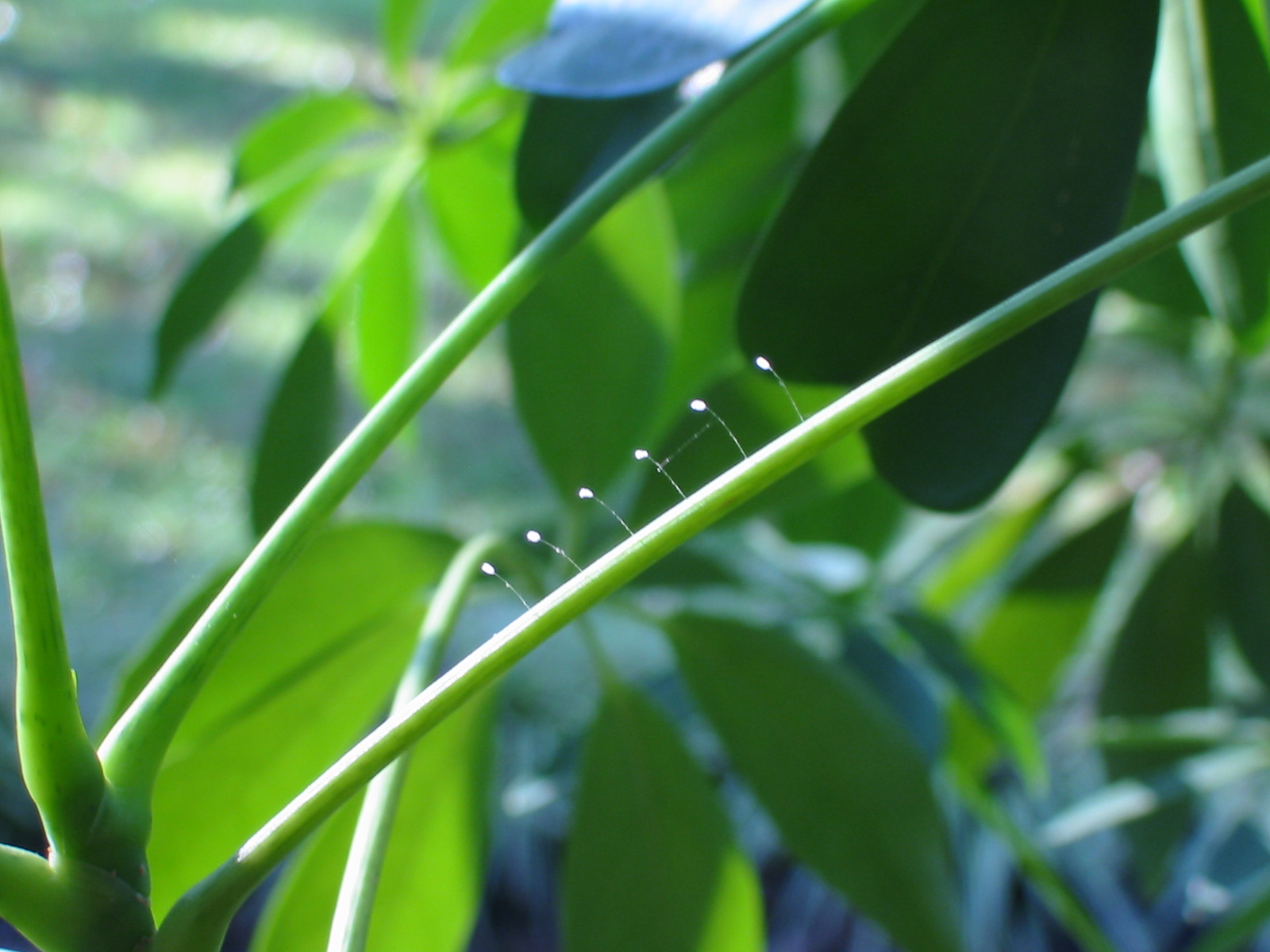
Green Lacewing Eggs
The miniscule space needles growing out of the shefflera stem above are not fungi.  They are the slim, stalked eggs of the green lacewing.  Lacewing eggs are usually laid on the undersides of leaves and stems.  They are a lovely surprise to find when working in the garden.  They seem so fragile that they would break or bend in the breeze, but you can brush your finger against them and they stand back up.  They are so delicate, that I can't feel them, even with my less calloused ring fingers.  They stand in peaceful beauty, glistening in the sun, while their infant lacewings develop inside each egg.  

Watch out, because after a few days, each egg cracks, and out charges a fierce, anxious monster of a teenage insect: the green lacewing larva.  It moves quickly and ranges widely, and it is hungry for fresh meat. It stalks, catches and eats every insect it can catch with its pointy mouth parts.  It kills its prey with toxic venom.  If it were 100 times larger, you would have to fortify your house and never go outside!  I'm certain some dangerous movie aliens are based on these ravenous killers. 

Scary green lacewing larva, source in picture.
After a few weeks, the green lacewing larva begins to feel full.  Its hunger for protein is sated.  It's ready to settle down, take up a peaceful existence and devote itself to future generations.  It finds a sheltered space under a leaf, wraps itself into a silk-bound ball, and metamorphoses into an adult.  The adult emerges, green and shimmering, and spreads its delicate, reticulated wings.  It floats off into the night, sipping nectar, mating and laying eggs.

Green lacewing adult with outstretched right forewing.
Don't fear the lacewing, even in its carnivorous stage.  It won't bite or sting you.  It will, however, remove hundreds of pest insects from your garden.  One lacewing larva can eat 200 aphids in a week!  Some organic gardeners buy and release lacewings onto their farms to help control insects.  Pesticides kill these useful farm workers, allowing pest insects to move back into the area with no predators.  Since pests can usually reproduce faster than prey, if both pests and prey are killed, you're likely to have a worse pest problem in a few weeks when the population recovers.  Encouraging beneficial insects like the green lacewing helps cut down on expenses, work and pesticide usage.  To encourage lacewings, plant flowers that the adults like, for example coreopsis, dill, Queen Anne's lace, cosmos and other similar plans.  You can also leave some of your dandelion weeds, because lacewings love them.

I apologize to my biologist readers for all the anthropomorphizing above, but these little critters seem very dramatic to me. 

Wednesday, June 22, 2011

Mmmmantis!

My favorite game to play with idle high school students was Stupid Ninja.  In Stupid Ninja, players each perform ninja moves, and the top move is always 'Mantis' because mantises are sooo bad (by which I mean fierce - high school terminology here).

Praying mantises are the voracious tigers of the bug world.  They are crafty, patient hunters that stalk their prey then pounce and chew.  They will hunt and eat anything they can catch - mostly other insects, but also birds and even reptiles, depending on the relative sizes of the parties involved.  They are indiscriminate carnivores, even eating their own siblings soon after hatching.  Their copulatory cannibalism behavior was a source of endless questions and freak-outs by my students.  One well-informed student:  "The female eats the male after mating!!!"......Everyone else in chorus:"Ewwwwwwwwwwwww!!!!!!"

There are a couple of going hypotheses to explain this infamous afterglow routine.  Some say that the female will be more tolerant of mating behavior by the male if she is to get a meal out of the deal.  For smaller males who cannot escape or battle competitors, this may be the price of passing on their genes.  It's the mantis version of the fancy dinner date with expectations, I suppose.  Others point out that a female who is well-nourished will be able to produce better eggs and egg-cases, thus helping to ensure the offspring of the sacrificed male.

Mantises are very useful bugs on the farm.  Predators in general help keep numbers of prey organisms lower.  The presence of predator insects help keep all the other insects in check.  They are part of this balanced ecosystem.  One aspect of Optimal Foraging Theory says that generalist predators tend to hunt for the most common species they encounter as their preferred prey species.  At any given time on a farm, the most common insect species is likely to be a crop pest, therefore predatory insects are always good to have around.

The farm owner and her 9-year-old son are delighted to welcome this year's group of bright green mantises to their farm.  They saved egg cases and shepherded the little hatchlings into their fields.  The son can easily find them upon request, which is quite impressive to me, since my much older students were unable to collect them for their insect collections for the past couple of years.  Mantises are known for their camouflage, so they can be tricky to find even when they are abundant unless you have spent enough time outside to be able to really notice what lives around you.

The egg cases are strange clumps of tough dried mucus filled with eggs.  Mantises overwinter as eggs inside the egg cases, and baby mantids hatch out in the spring.  They grow all summer long, and mate and lay eggs (or get eaten) by the end of summer.

You can go on a mini-safari if mantises are around.  Bring a camera, wear long pants, and sit in the weeds near a praying mantis.  They love to sit under flowers, since flowers attract flying food.  Be patient and watch carefully with your camera poised - he hunt is already on.  The mantis will sit and wait for its prey.  Then, when something buzzing comes near, the mantis will ambush in a flash.  One moment there will be two insects, and the next there will be only a mantis holding its lunch and chewing happily.  It's thrilling and slightly scary to watch, and you will learn some bad Stupid Ninja moves.

Here's a young adult mantis hiding in the seedlings: