Friday, May 18, 2012

Trilobites at the Chicago Field Museum

Museums can make great places for social outings, but I also love going to them alone.  I can skip the uninteresting parts and obsess as much as I want over the good parts.  On a recent trip with friends to the Field Museum a few weeks ago, the miles of enticing, juicy exhibits drove me mad with unsatisfied curiosity.  So I went back by myself and spent an entire day!

Who knew trilobites had such amazing appendages?
There was so much to see, but my absolute favorite was their collection of exquisitely articulated trilobite fossils.  Trilobites were among the earliest Arthropods, which are the jointed-appendaged animals like insects, spiders and roly-poly bugs.  They were commonly-fossilized animals from about 525 million years ago through 250 million years ago, which is an astonishingly long period of time in evolutionary history.

Trilobites are so much cuter with antennae.
I'm not sure how these fossils were separated from their surrounding rock, but their details are incredible.  Looking at these fossils, I could imagine these little critters skittering across the ocean floor and using those appendages to sense water movement and scent of prey items.
Trilobite diversity.
The exoskeleton of trilobites was thick and tough, which made it easier for fossils to form.  Scientists have been able to study the evolution of eye structures, other sense organs and delicate feeding apparatuses over time using trilobites.  There was considerable diversity of trilobite species.  It is not understood why trilobites went extinct.  Their closest living species relative alive today is probably the horseshoe crab.
A trilobite called Walliserops with what has to be a smell/taste organ on its front end.


Thursday, May 3, 2012

Black Crowned Night Herons in Lincoln Park


There is a surprising diversity of animal life in Lincoln Park, and that's not even counting the zoo animals.  The latest residents of the park are what appears to be dozens to several hundred nesting black crowned night herons.    The two lumps in this picture are black crowned night herons.  Don't see lumps?  There's one in the center and one left of center near the top.  Try squinting. (Another neat thing about the picture is the lack of overlap in the adjacent tree canopies - competition for light.)
Black Crowned Night Herons Nesting in Lincoln Park
During the day, night herons sleep and nuzzle and generally take it easy.  I'd love to show you a picture of how cute this is, but the area is fenced off, and I don't have a zoom lens.  Trust me - it's cute.  Imagine fat birds cuddling with their heads tucked into each others' feathers.  Here's a better picture from the Lincoln Park Zoo website.  As the birds sleep on their nests or on nearby branches, the wind is waving the branches around like mad.  I wonder what it feels like to have wild rocking be one's version of sitting still.  It must make standing on solid ground feel uncomfortable.

These night herons are nesting in Lincoln Park for the second year in a row.  According to a birdwatcher I met by the night herons who seemed to know everything, this population used to nest in a wetland southeast of Chicago that was destroyed.  Then they moved to an island near Lincoln Park, and last year they moved here - just south of the zoo along the main promenade.  The zoo and the park have erected fencing around the nests for two years now, cutting off the main thoroughfare in the park for several weeks.  Everyone seems to be happy to welcome the birds, and they are back despite the busy park traffic, bagpipe players, dogs, soccer matches and live music concerts.  It will be interesting to see if the new habitat allows their population to survive or diminish.  They have nested earlier due to the extremely mild winter. 

Night herons hunt at night, and they eat all sorts of small meat items - fish, frogs, birds, squirrels.  Given the number of squirrels, geese and ducks in the park, it may be a good thing to have a top predator around to help control populations of these other organisms.

Tuesday, April 24, 2012

Parthenogenesis and the Dandelion

If you've been following along, you know that flowers are the sex organs of plants, specifically adapted to combine half of the DNA of a male plant (in pollen) with half the DNA of a female plant (in ovules) to produce a new plant, packaged in layers of a seed and wrapped in a fruit.  Sexual reproduction allows for each parent to pass on some of his/her genes to make an offspring that is combined from those genes.  It's why we all can see a little of each of our parents when we look in the mirror, and plants would too, if they used mirrors.  Unless they are dandelions.

Dandelions and Lake Michigan
Common dandelions, belonging to the species Taraxacum officinale, mostly do not reproduce sexually, though a few dandelions in Southern and Central Europe do.  The dandelions in North America are all clones of a few original European dandelions.  The method of cloning, or asexual reproduction, used by dandelions is called parthenogenesis.  In parthenogenesis, offspring are produced that look like normal offspring - starting out as embryos and growing to adults (versus asexual reproduction by fragmentation where the adult parent breaks in two, and viola, you have two new organisms).  For plants, parthenogenesis usually means producing ovules that have a complete copy of the mom plant's DNA, called apomixis.  The apomictically-produced ovules develop into seeds that are genetically identical to the mom plant, and there is no pollination involved.  That's female liberation (though there is a plant that does male apomixis!).


Dandelions decorating a lawn.
It takes a while to get used to the idea that plants have sex, but once you think about it, it makes perfect sense.  Sexual reproduction allows for continuity of traits being passed on from generation to generation along with genetic variation to survive in diverse habitats.  After you're used to 'normal' plant reproduction, parthenogenesis seems positively bizarre. Why would a plant want to give up on genetic diversity? Actually, lots of plants reproduce asexually by parthenogenesis (blackberries, onions, grasses and more), and there are some specific advantages.

The main advantage to asexual reproduction is the ability to capitalize on a successful genotype.  If humans could do this, we might have hundreds of little Steve Jobs growing up to make our future world a better place.  Instead, he left us a few offspring, but they each only have half his genes - and they may or may not have gotten the good ones.  For dandelions, their successful growth strategy can be reproduced in perpetuity because they are identical copies, with only random mutations providing genetic diversity.  Dandelions may have less need for genetic diversity, since the DNA they have allows them to grow differently depending on their growth conditions.  This is what makes them such successful and widespread weeds.

One last issue for today:  dandelions grow without being pollinated, but most dandelions do produce pollen (Did your childhood friends used to rub dandelions on your face?  Remember the yellow dust they left behind?).  Botanists scratch their heads a bit on this issue.  Dandelions that don't produce pollen can make more seeds, since they are not wasting their energy.  It may just be that because pollen production is genetically determined and dandelions don't evolve very quickly, the pollen production may just be an evolutionary leftover.  Also, there are some sexually-reproducing dandelions in the world, so if dandelions maintain the ability to pollinate potential dandelion mates, they could just happen upon a better combination of genes than the ones they already have.  I don't know that dandelions really need to become more successful at growing...though I love them, we have enough already!

Monday, April 2, 2012

Massive Pollen Overload: Hello Spring Allergies

Brace yourself.  These pictures are of terrifying plant structures that cause much anguish to their human victims, and the overall post is frankly somewhat disturbing.  Be brave.  For the first picture, imagine some ominous, slow, suspenseful music, because a threat is just beginning to emerge from its lair.  Yes, the picture below shows flowers from a wind-pollinated tree emerging out of a bud.  The tiny green globs in the picture below will open and shower the world with..........pollen!!! No!!!!  These innocent-looking little guys are going to make you miserable for the next few weeks.


Leaf and flowers emerge from this hornbeam maple tree bud.


"Can those really be flowers?" you ask. "They're so small and boring-looking." Well, not all spring flowers are beautiful and showy.  When flowers are conspicuous, you can rest assured that they are not causing your spring allergies.  Beautiful, sweet-smelling flowers are attempting to attract insect pollinators, and insect-transported pollen sticks to the flower, then to insect legs, and it does not blow in the wind.  Tiny, green, anonymous-looking tree flowers are usually wind-pollinated, which means their pollen is dusty, copious, and perfect for floating along on a breeze to any location, including your sinuses.

"Why do plants make all that pollen?  What's the purpose??!!"  You're asking a lot of questions today. Unfortunately, if you are reading this and sniffling due to a nose full of pollen, you might find my answer to be a little disconcerting.  Pollen is the plant equivalent of sperm.  So, yes, your sinuses are clogged with plant sperm.  Pollen is produced by the male parts of flowers, and it combines with the ovule in the female part of flowers to produce a fertilized cell that will develop into a new offspring plant.  In this picture, you can see the female parts of tiny winter hazel flowers reaching into the air to snag pollen grains to make some new baby hazel seeds that will grow into new hazel trees.


Winter hazel flowers with stigmas reaching out to catch wind-borne pollen.
If you were to look at grains of pollen under the microscope, they wouldn't look much like sperm.  Pollen has varied shapes, depending on the tree.  Here is a book of scanning electron microscope images of different types of pollen - amazing stuff!  My favorite is pine pollen, shaped like Mickey Mouse's head (Google it).

Pollen does a very, very, very strange thing when it fertilizes plant ovules.  When pollen lands on a female flower structure, it divides into three sperm cells, with actual flagellae.  The sperm swim down a channel in the female structure of the flower.  One sperm fertilizes the ovule, as we would expect based on what we learned about human anatomy in 7th grade.  The other two sperms combine with another cell near the ovule to make a substance called endosperm.  The endosperm is genetically the combination of two parents, but it is not really an offspring.  Endosperm is the structure inside the seed that stores food for the new growing plant.  For example, in a corn seed the endosperm is the starch in the corn kernel (yes, popcorn is exploded endosperm, and the little nubs in popcorn are toasted corn embryos....mmmmm!). Now you know why I put three "verys" in the first sentence of this paragraph.


New leaves and flowers hanging in clusters called catkins on a red oak tree.

Oak trees (pictures above and below) are my favorite trees, so don't think I'm picking on them.  They are pretty bad at making giant clouds of pollen.  Pines are even more intense.  There are a few days in spring in Georgia that you really don't want to be outside because the pine trees seem to spew pollen like snow-making machines spew snow.  If you catch a tree as it's releasing pollen and shake one of it's branches, you can make a nice, yellow cloud in the air.

When pollen lands inside your nose, the membranes in your nose recognize it as a foreign object to be removed.  Your body leaps into action with sneezes, mucus production, and swelling (which can cause headaches) in order to get rid of the pollen.  This immune response can make you tired and uncomfortable.  Fortunately trees only make pollen for a short period of time.  The benefits of having lots of trees near you (shade, habitat, aesthetics, food, property values, reduced heat bills, etc.) vastly outweigh the annoyance of allergies.  If your spring allergies are really bad, stay inside and be sure to wash your hair and clothes after you go outside to keep the pollen away from your nose.  And just wait around a few days for a spring rain shower, and the pollen will be gone.

New leaves and catkins on a white oak.


Wednesday, March 28, 2012

Maples in Early Spring

If you live in the temperate eastern United States, and you only know one kind of tree, it's probably going to be a maple.  Everyone knows maples.  People either recognize and love maples' unique, pointy leaves, enjoy maple syrup, admire bright fall maple trees, or played with maple helicopter seeds as kids.  Few people know what maples are up to this time of year, though.

Even without leaves, maples are very busy this time of year.  Look at the ends of the branches on this maple tree below:  there are lumps all along the branches.


Swollen maple buds ready to pop.  Early March.
Those lumps are flower buds.  Many maples flower and fruit before they leaf out.  Here is a closeup of maple flowers:
Mid March, maple flowers.
Maple flowers are pollination generalists.  Some are pollinated by insects and bees, some are wind pollinated, and some are self-pollinated.  From the tree's perspective, it pays to be flexible with pollination strategies if you bloom very early in the growing season, because it's difficult to insure that insects will be out when you're ready to bloom.  Insects are really the best pollinators.  They are great at pollinating over long distances with small amounts of pollen, but they require warmer temperatures to do their work.  Wind pollinates cheaply - you don't have to feed it nectar or a portion of your pollen to get it to carry your pollen to another flower.  But wind isn't very specific in direction, so you usually need to make a lot of pollen if you are using wind (more on this next time!).  Self pollinating is convenient, but let's face it, you don't get much genetic variety if you make kids using only your own genes. 

Either way, lots of pollination has happened, because the maples in Chicago are LOADED with maple fruit.  Notice I called these helicopter things seeds earlier in the post, and now I'm calling them fruit.  I didn't want to alarm you earlier, but here's how this works:  fruits are plant parts that hold seeds.  An apple fruit has seeds in it, and so does a cucumber, and so does a maple fruit.  The maple fruit consists of a wing and a case around the actual seed.  Open up the swollen end of the fruit, and you will find a sticky seed (and you can stick the fruit on your nose or fingers like we did when we were kids).
Maple fruits (samaras) in late March.
Maple fruits are winged, and they are adapted to being carried far away from their parent tree by the wind.  They do indeed work like helicopters - their wing catches the wind and spins them along to hopefully sunnier ground than the ground just under their parent tree (maples are indeed shade trees).  There are many types of fruits out there: berries, capsules, hesperidia, drupes, pepoes, etc.  Fruits with wings are called samaras.  Both maples and ash trees have samaras to carry their seeds away.


New (red!) maple leaves, plus some maple samaras, late March.
Above you can see some new leaves just starting to grow on this maple. I had to look hard to find maple leaves on this type of maple tree - they mostly have only fruit right now.  Below you can see two pictures of early leaf growth on a Japanese maple.  Japanese maples seem to usually leaf out before they set fruit.


Japanese maple leaf buds opened and showing the new expanding leaves, late March.

Slightly older Japanese maple leaves, late March.


Monday, March 19, 2012

Buds of Spring

A few weeks ago, I explained how to tell the age of a twig, and last week, I showed you the amazing colors of photosynthesizing spring twigs.  Well, it's apparently twig month.  But don't worry, twigs are fascinating, and we haven't wrung all the goodie out of them yet.   


Buckeye leaf buds.
Today we'll focus in on buds, since that is what seems to be the most active biological phenomenon in Chicago at the moment.  Buds of many trees and shrubs are starting to grow, and I have become fearful of checking the weather report since we're well before the last frost date for this growth region (April 20).  I know we're going to see lots of branches with melty, drippy dead leaves one of these days.

As you can see from the picture above, I finally found a buckeye, the best twigs for learning twig structures.  Even with the mediocre picture quality, you can see the giant bud scales and leaf scars.  The terminal bud has almost doubled in size and is about ready to pop out some leaves.

Shrub buds leafing out.
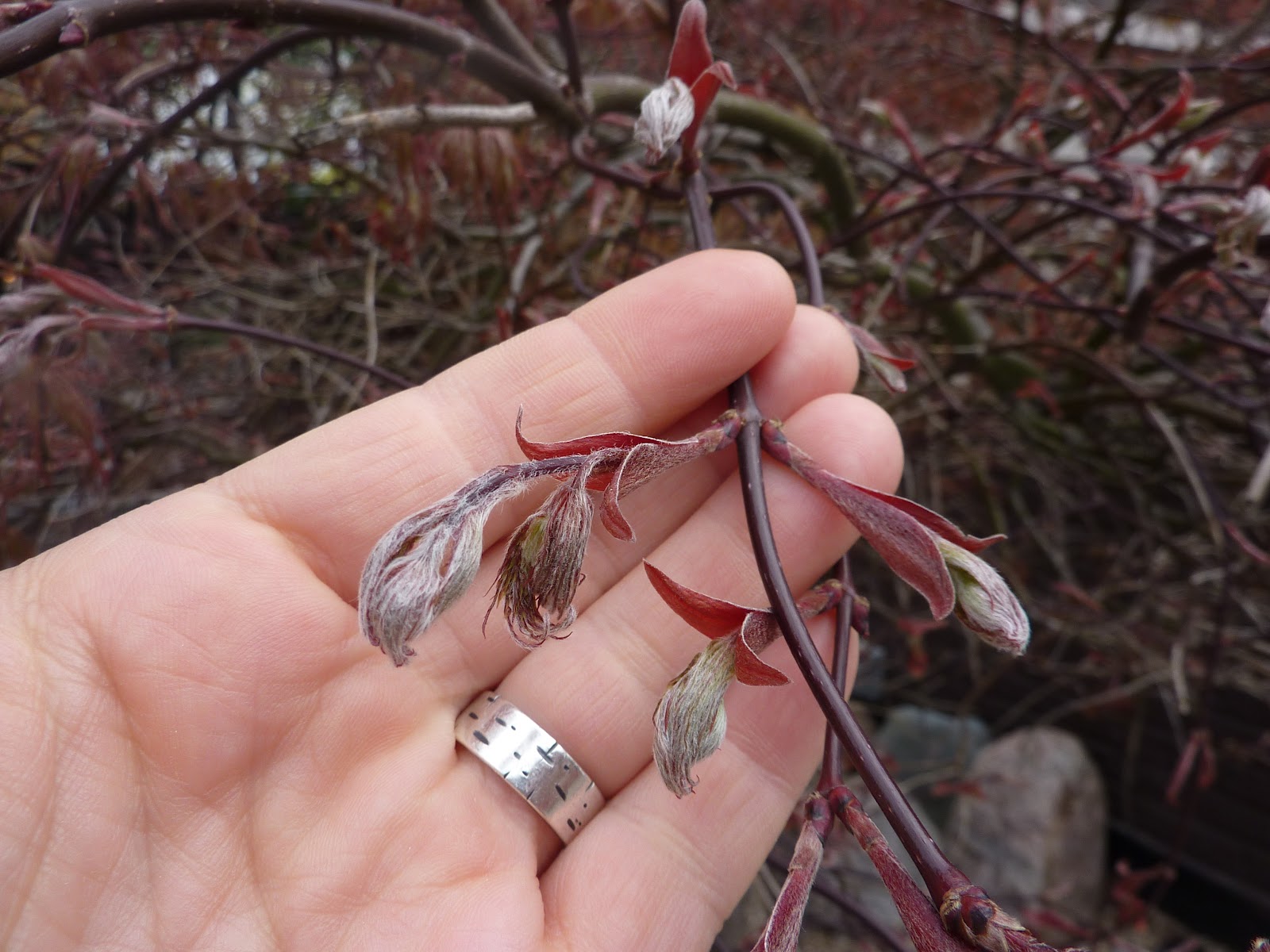
In the photo above, of a mystery shrub I have not yet identified, the double terminal buds have expanded so much that you can see individual leaves.  I didn't stop to get a better picture because the house owner came home while I was photographing his buds, and we had an awkward moment.  In a better picture from buds at the Lincoln Park Zoo, below, you can see miniature leaves, and the terminal bud scales are still present at the base of the leaves.  No doubt zoo patrons were wondering why I was taking pictures of a shrub and not the demonstrating chimpanzees right behind me.  They'll just have to start subscribing to my blog to find out.  Loyal readers (hi Mom and Dad), any guesses why these new leaves are reddish?

Shrub buds leafing out.
The picture below introduces you to a new plant structure, the flower bud.  There are a cluster of tiny dogwood flower buds between my fingers, surrounded by four flower bud scales.  Any plant bud is just a beginning of a new plant structure.  So you can have leaf buds, flower buds and even root buds.  Inside each bud is a small cluster of the plant equivalent of stem cells.  Plants' stem cells are called meristematic tissue, and a cluster of these cells are called a meristem.  Meristems are the specific cells capable of growing new plant tissue.  Most plants have meristems in their tips, like in buds.  Plants like grasses have meristems near their bases, which means they can easily grow back after you run the lawnmower over them.

Dogwood shrub flower buds.
Below is a gorgeous magnolia flower bud.  You can see hairy bud scales and light pink flower petals beginning to emerge.

Saucer magnolia flower buds.
Next are the flower buds of a plant so famous for buds that it is named after them: the redbud tree.  Redbud buds are a little strange - they can grow out of a mature twig or even out of the tree trunk.  This phenomenon of flowers emerging from the mature wood instead of from new green growing tips is called cauliflory, and it's quite unusual.
Redbud buds.
I've saved the best picture for last.  I found these strange objects on the ground in the perennial garden section of the Chicago Botanical Garden.  There are red, papery bud scales and bunched up green leaf babies crammed inside the red buds emerging straight from the ground.  I had to ask, since I've never seen these before, and it turns out they are rhubarb buds!  The leaves will expand and grow remarkably quickly, since they are so fully formed inside the buds.  Then I will turn the stems into a pie.

Rhubarb buds.

Thursday, March 15, 2012

Gettin' Twiggy With It

A trip to the Chicago Botanic Garden this morning provided me with much blog fodder for this and the next few posts.  Spring is early this year, bringing a bounty of beautiful sights to the Botanic Garden. 

Greenish yellow weeping willows and orange willow shrubs on the left side.
Many trees and shrubs have responded to the spring weather, even if they haven't leafed out yet, by becoming quite colorful.  Their twigs have begun to manufacture photosynthetic pigments near the surface of the bark, making for yellow, orange, red and green twigs.  Forget everything you ever learned about plants - they photosynthesize using bark! (OK, don't forget anything, but you can add on.)  The picture above shows a lovely spring scene with willow trees and shrubs revealing their spring pigments.
Crimson tipped shrub willows.
The brilliant colors of the shrub willows drew me in for a closer look.  Up close, they have yellow stems with bright red tips.  The greenish yellow of the lower stems is probably a mix of chlorophylls and xanthophylls (here is an explanation of pigments in this earlier post).  The red is likely due to anthocyanins, but there is almost certainly chlorophyll also present in the twigs masked by the stronger red pigments.
Willow twigs with crimson tips.
Red is a common pigment 'choice' for plants that are active in cold weather.  The red may act to filter out some excess light and act as a sunscreen for the plant.  Plants can't photosynthesize as quickly when it's cold out, and too much light can overload the slow system.  Red pigments also tend to absorb more heat than other pigments, and even a tiny increase in temperature can increase the rate of photosynthesis.  In this crimson-tipped willow, the narrow tips would be especially likely to freeze, so red pigments there could help them be more active in the cold.  Alternatively, since this plant is growing in a botanic garden, it is likely the product of selective breeding for aesthetically pleasing but physiologically useless traits - so the colorful twigs could just be pretty and not useful at all.

Red dogwood twigs.
Above you can see entirely red twigs of a shrubby type of dogwood.  I can attest that many types of dogwood twigs are often red in the wild as well as in botanic gardens.  People and nature seem to favor red twigs for winter growth.  The overall effect (below) of these red twigs is startlingly beautiful.

Dogwood shrubs.
Many plants opt for green chlorophyll for winter twigs, as seen this variety of rose-related shrub below.  These stems can actively photosynthesize any time the temperature and light are favorable.  The tough, thick stems are able to survive freezing where leaves cannot.  When the temperatures rise to predictably non-freezing levels, these roses will leaf out and photosynthesize in earnest for the growing season.

Rose stems.
When we came to Chicago in October, forecasts said it would be the worst winter ever.  Instead, it's been a record-breakingly warm winter.  Spring seems to be competing to outdo winter's numbers.  It's been 80 degrees for days now.  Plants that use temperature as a trigger to emerge from winter's dormancy are already leafing out.  Those that use day length as the gauge for the start of spring still look like they should for this time of year - leafless and grey.  I suspect the day-length strategy will work better this year, since Chicago has been known to have freezes into April.  Trees that leaf out early stand a good chance of having to grow new leaves after their first ones get frozen off.  Late leaf growth combined with twig pigmentation is a good strategy for climates with unpredictable spring temperatures.  Using twigs to photosynthesize can give a tree a good head-start on the growing season without the risk of having tender plant parts frozen off.