Showing posts with label seeds. Show all posts

Monday, May 13, 2013

Ferns Unfurling into the Future

Since spring is the time of transition, this blog is transitioning too.  It is time for my final outdoor classroom blog post.  Next time, I will return to my original "Biological Thinking" blog of discovering biological phenomena in everyday encounters with nature.  I hope you stay tuned if you have enjoyed my site-specific posts.  Thank you for reading!
A Fern Leaf
Our final topic: ferns.  Ferns are so common in the South that it is easy to overlook their strange beauty.  In the summer, many people display ferns in baskets outside their homes or apartments.  If you walk through the woods, ferns contribute to much of the background green of the understory.  Their repetitive intricate form makes them ideal for adding greenery to bouquets.  They are so familiar, yet they are so unusual. 
Fern spore-producing structures called sporangia.
Most plants we know of produce flowers and seeds to grow their offspring.  Seeds are tiny plants with a starter food supply wrapped in a protective coating.  They are produced from flowers.  When a seed grows, the tiny plant in it gets larger until it is a hackberry tree or a clover plant or, well, you get the idea.  Ferns, however, do not make flowers or seeds.  Fern plants make spores.  Spores are microscopic bits that are so light they can blow for miles on the wind.  When they land, if conditions are moist, they can grow into a small green leaf-like flat structure called a gametophyte.  The gametophyte looks nothing like a fern - just a tiny green patch.  The gametophyte grows for a while on its own, then it produces structures that can grow into a full-grown fern.

It's difficult to find gametophytes, but its easy to find spores.  Just look for dots on the bottom sides of fern leaves - those are pockets filled with microscopic spring-loaded spore-launchers called sporangia.  If you could shrink yourself, you could hang out under a fern leaf just for the fun of watching the tiny sporangia catapult their spores.  Nature's microscopic fireworks!
How leaves of flowering plants open up.

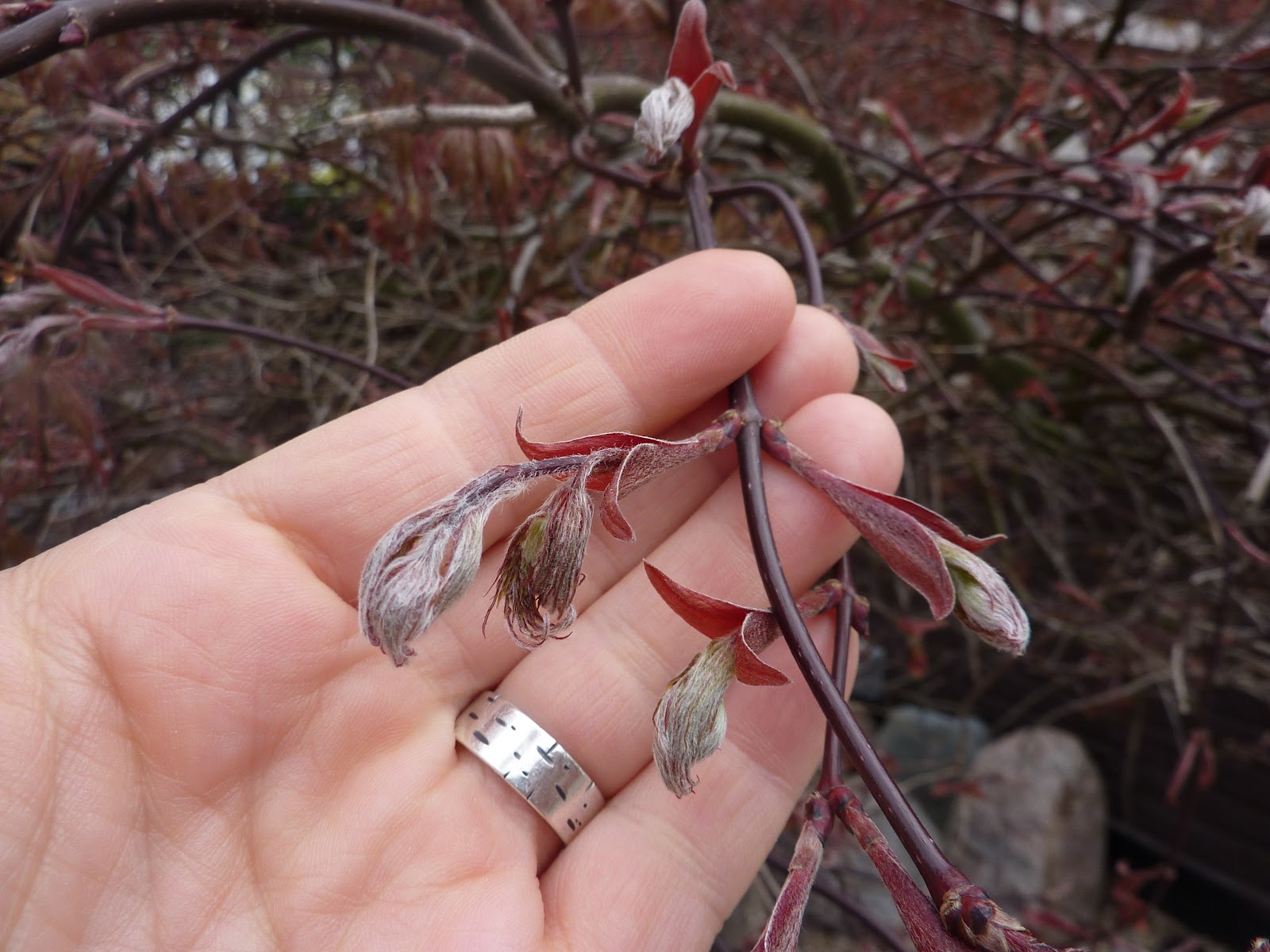
Another difference between ferns and flowering plants is how their new leaves open up.  The above plant, a flowering plant, has new leaves that are enlarging and opening by unfolding.  The young leaves are small and creased, the mature leaves are open and flat.  Below you see a fern leaf opening up.  Young fern leaves are small and curled up.  When they grow, they unfurl or unroll.  Young fern leaves look like the tops of violins (also called fiddles), so young fern leaves are called fiddleheads.  Fiddleheads might be green or brown or hairy or look quite different than the leaves they mature into.  It's easy to find fiddle heads in the spring and early summer - just look around the base of fern leaves, which we have in abundance all over our outdoor classroom.
Fern fiddlehead with a spore-producing leaf behind it.
There is a term for the unfurling of fiddleheads, of course, since there is a term for everything in science.  It is perhaps my favorite scientific term: circinate vernation (pronounced SIR-sun-ate ver-NAY-shun).  Look at the first word: circinate.  What other word starts with circ-?  Circle!  Circinate means circling or spiraling.  The second word might be tougher to figure out.  It derives from the word 'vernal', which means spring.  So circinate vernation is literally the unfurling of the spring, which is what ferns do.
More fern fiddleheads.
Ferns are ancient plants on earth.  Well, the plants in our outdoor classroom plant beds aren't ancient - they are the same age as their flowering neighbor herbs.  What I mean is that ferns were present on earth before flowering plants evolved.  They were some of the earliest plants in the fossil record, and they used to be the dominant type of plant on earth.  Now ferns are all fairly small plants, but before there were trees like we have now, ferns could be any size up to as large as small trees.  Ferns spores are a limitation that requires moist habitat, so ferns can't grow everywhere.  When some plants evolved the ability to form flowers and seeds, they could live in many types of habitats, so the flowering plants out-competed the ferns and became the dominant types of plants on earth. 
This fern leaf is almost completely unfurled.
All plants, including ferns, use photosynthesis to capture the sun's energy and make food.  Like flowering plants, ferns have xylem and phloem vessels for transporting food and water.  There are even more simple and ancient plants still easily found, even in our outdoor classroom: the mosses.  Take a look at the plants covering the rocks behind with waterfall.  They are mostly mosses, which don't have flowers, seeds, xylem or phloem.  They still photosynthesize, and they make spores like ferns do.
Moss - an even simpler plant than ferns.
If you want a more ancient plant than moss, you have to look into the pond at the algae.  Which brings us back to the very first topic we started with in August! 

I will leave you with one last picture of a fiddlehead getting ready to open up and live its life in the world.  It's so full of possibility!
A young fiddlehead.


Sunday, March 31, 2013

Sycamores, Trees of Wonder

If you were to decide to learn only one tree in your life, I would recommend learning the sycamore (though I don't recommend learning only one tree).
A stately sycamore between our outdoor classroom and playground.

A friend once told me that sycamores are easy to recognize because they are the only tree that wears pants.  A sycamore's upper limbs are white and appear to be uncovered, and its lower trunk is covered with brown, patchy bark - the sycamore's pants.  Sycamore bark consists of three layers: the outer is brown, the middle is greenish and the inner bark is white.  Sometimes you can see all three layers together in a camouflage-like pattern.  The outer two layers peel off of the upper limbs, leaving bone-like white branches that look spectacular against a blue sky.  Scientists aren't sure why the upper bark peels off, but some people think it falls off to prevent vines from being able to grow up into the treetops. 

Sycamores tend to grow near water, and since their white branches are visible from a distance, they are useful for finding water if you are ever lost in the forest.  Early explorers used them to find water sources across North America, but they used sycamores for lots of other things too.  Sycamores are very fast-growing, so they produce a lot of wood.  Though sycamore wood is twisty, it is extremely strong and light, and Native Americans and settlers both used it to make just about everything you can make out of wood.  Before North American forests were logged, most forests contained trees that were a lot older, therefore they were bigger than trees we have now.  Old sycamores tend to be shockingly enormous compared to other trees, and they are often hollow (here's a medium-sized one, and possibly the world's largest), so sometimes they were used by people as a shelter or to corral animals.
A drift of sycamore seeds and a few pieces of fallen sycamore bark.
The sycamore tree at our school is making a mess right now.  While more northern parts of the country still have snowdrifts, here in Middle Tennessee, we get drifts of sycamore seeds.  Sycamores hold their seed balls (technically fruits) up on their branches all winter, but now the seed balls are dispersing their seeds.  Every ball contains hundreds of wind-dispersed seeds that each have a few feathery hairs to catch the wind.  Some of the seed balls break apart while they are on the tree, and the seeds are dispersed from high in the sky.  Many seed balls fall onto the ground as well.  Mostly the seed balls break apart when they fall off the tree.  The seeds are only loosely-held together, so the seed balls usually smash to smithereens on impact with the ground.  If you're lucky, you may find a whole seed ball, which is exceedingly enjoyable to break apart for yourself.
A sycamore seed ball with a few seeds falling out.
 If you lightly crush the seed ball, you can see how the seeds fit together so tightly. 
A lightly-crushed sycamore seed ball.
Once you have completely crushed the seed ball, look for the hard structure inside.  That structure is the base of where the seeds are produced, and it looks like the strangest type of seed or fruit you've ever seen, but it's neither seed nor fruit, just stem.  Many naturalists have been confused when trying to identify these structures when they find them without the surrounding furry sycamore seeds.
A fully-crushed seed ball.
Soon our sycamore will look very different.  It will be covered with giant plate-sized sycamore leaves, but you will still be able to recognize it by its beautiful white branches.


Friday, February 8, 2013

Nandina: A Berry Interesting Problem

Oh, nandina, nandina, you trouble my heart!  You are so beautiful all winter with your green foliage and bright red berries, but you are an invasive plant.  What is a good naturalist to do?
Nandina, AKA heavenly bamboo.
Invasive species (species = type of organism) are a problem in Tennessee, and in the rest of the world as well.  They are currently the #2 cause of extinction of other species, just after habitat destruction.   Invasive species are non-native organisms that grow like crazy and take over.  Non-native organisms are moved from one part of the world to another, mostly by humans.  This is usually not a problem, except that for some non-native species, the new habitat has none of their usual diseases and predators, and the habitat seems to fit just right.  In that case....they can take over and crowd out the habitat of other organisms.  Nandina is native in Asia - from Japan west to India.  It is a beloved plant there, also used in landscaping like we use it here. 
Poisonous beauty: these berries contain nandina seeds and cyanide!
In Tennessee, some of our most harmful invasives are bush honeysuckle and kudzu.  Bush honeysuckle uses up habitat for other plants.  Also, birds that nest in it are more likely to get eaten (not sure why).  Kudzu simply crowds out every living organism where it grows.  Nandina is not that bad!  It is usually only found growing wild near where humans have intentionally planted it.  The Tennessee organization that helps keep invasive plants under control (TN-EPPC)  wants more information about nandina in order to keep tabs on the problem.  If you are ever out hiking in the wild (not in a landscaped yard) and you see a nandina, TN-EPPC would like to know about it.  You can report an escaped nandina at the TN-EPPC website: http://www.tneppc.org/
A nandina draws your gaze from behind a sedimentary rock.
Biologists worry about invasive species because they cause the total number of species to decrease.  The loss of a species, or extinction, causes the loss of a participant in an ecosystem.  For example, when a bird species dies out, an ecosystem might lose a seed-disperser.  If honeybees died out, there would be way fewer pollinators and thus way fewer fruits and seeds.  If a type of beetle died out, we might lose a soil recycler. 

Nandina is guilty of taking up a tiny bit habitat that would otherwise be used by native species, though it doesn't appear extremely aggressive.  It has another problem, though.  Nandina berries contain a toxin called cyanide.  Birds in the US haven't figured out how to deal with the poison, and some cedar waxwing birds have died from eating lots of the berries.  The berries can be toxic to any other animal too, so don't eat them. (It probably takes a lot of berries to hurt a large animal such as a human...still...don't eat them.)

Back to the original question: what's a good naturalist to do?  That depends on who you ask.  Some will say to never plant nandinas.  Others say plant them but clip off the berries this time of year when birds start foraging.  Others say don't worry about it - eventually the other species will adapt and nandina will become another important part of our ecosystem.  The only problem with this last option is that adaptation takes hundreds to thousands of years, so we won't find out how nandinas mesh with our Middle Tenneessee ecosystem for a looooonnnngggg time!  What do you think we should do?

Tuesday, September 11, 2012

In Praise of Black Walnuts

You might want to wear a hard hat next time you go to the outdoor classroom.  There is a black walnut tree in the back corner, and it's walnut season!  If you sit there long enough, you might just witness the loud thud of a walnut hitting the ground.
Here's our black walnut tree.
Black walnuts (Juglans nigra, meaning black Jupiter nut) are beautiful trees.  I like them because they provide light shade (not too dark - their leaves are sparse and let the light through), give us delicious nuts, provide food for squirrels and are an excellent source of wood.  The dark walnut wood is so beautiful, strong and light that a full-grown walnut tree can be worth $5000 or more if it is cut down and sold for wood.  Plant a few walnut trees today and harvest them in 30 years for an excellent return on your investment.  Plus you can eat the walnuts in the mean time!  Just be sure to re-plant what you harvest.

Whole in-shell walnuts are available  in grocery stores this time of year.  They are a great snack, and since they take a while to crack open, you can't spoil your dinner with them.  The grocery store walnuts are English walnuts and ours a black walnuts, but our walnuts are still very good to eat.  In fact, their strong wal-nutty flavor makes them superior for adding to ice cream, fudge and cakes.  You just have to catch them before the animals do.
A black walnut with the husk still on.
Walnuts grow with a husk on them that makes them look like big round limes.  The husk contains a chemical called juglone that makes it smell rather pungent and stain your hands brown if you touch it too much (it won't hurt you, but you can't wash it off).  The juglone in the walnut husks also seeps into the ground under walnut trees and prevents some plants from growing, which helps prevent walnut trees from having too many competitors for sunlight and soil nutrients.  This plant warfare technique is called allelopathy, and it's fairly common among plants to have secret chemical wars going on in the soil.  Smell a walnut husk and notice the bitter juglone smell.  You can also smell the same odor in crushed walnut leaves.  Every fall, the walnut leaves fall and add a new dose of juglone to the soil.  Juglone is also a potent dye and is used by dye-makers to color fabric.  You could try this out by soaking a cloth in crushed walnut husks and water.
Black walnut with squirrel teeth marks in the husk - I bet that tasted awful!
My dad taught me a special technique for removing walnut husks: put a bunch of walnuts in your driveway and drive back and forth on them.  You should be left with a bunch of crumbled husks and intact walnuts.  You could also just wait for the husk to turn black and rot away, but by that time your walnut has probably become infested with worms or fungi.
Chewed hole in a walnut shell with the entire nut removed by a squirrel.
After you remove a walnut husk, the next challenge is to open the walnut shell.  Black walnuts have stronger shells than English walnuts.  My dad's trick for walnut shells is to wrap several walnuts in an old towel and bash them with a hammer.  Very fun.  Then you can use tweezers and a nut pick to pick out the walnut pieces from the shells.  It's a messy business, but totally worth it.
Whole walnut with husk, walnut with husk partially chewed, walnut without husk, and opened walnut.
Search around the bottom of our walnut tree and look for walnuts with the husk on, with a rotted husk, with the husk gone and with the shell open.  Look closely and you will find walnuts with teeth marks from the industrious squirrels that like walnuts for the same reasons we do.  Squirrels have gigantic, orange chisel-like teeth that you can see here.  They scrape their teeth through the husk (ick!) and the shell, then dig out the walnut with their teeth, tongue and claws.  If there are enough new green walnuts, you might want to take one with you and open it yourself - they are delicious!
Black walnut tree.  If you click on the picture, you can zoom in a see clusters of walnuts.
Walnut trees do not grow walnuts in order to provide us with snacks.  The walnuts are actually the offspring of the walnut trees.  The nut part is actually a seed.  If you put a whole in-shell walnut in the ground this fall, it will sprout and grow a new walnut tree in the spring.  The food value of the walnut - the part we like to eat - provides food for the new walnut tree until it can grow enough leaves to use the sun for food.

Here's more information on harvesting black walnuts if you'd like to do a more serious walnut harvest.


Sunday, June 24, 2012

Three Sisters Molé Enchiladas with Blackberry Salsa


This is a special cooking edition of my blog.  Don't panic - cooking is nothing more than applied Biology (and Chemistry and Physics and Math and Art...), so there are some way interesting biological phenomena to write about here.  One of my cooking heroes, Isa Chandra Moskowitz, has issued a cooking challenge, and I took the bait.  Isa Chandra is the author of several vegan cookbooks, including Appetite for Reduction, the most useful and well-thought-out cookbook I've ever used.  The challenge is to cook a vegan entrée in under 40 minutes using black-eyed peas, bittersweet chocolate, mint and blackberries.  The recipe must be published on the internet, and there are prizes and fame/fortune involved.  I'll report back about the results of the contest!

Here is a picture of my invention, Three Sisters Molé Enchiladas with Blackberry Salsa: 
Three Sisters Molé Enchiladas with Blackberry Salsa
The contest ingredients got me thinking about agricultural centers of origin.  Agriculture started in many concentrated locations (centers of origin) throughout the world, and cuisines arose based on what crops were domesticated from the species growing in the area, with foreign ingredients added in to the extent that cultures traveled and mixed.  See if you can match the crops with the center of origin here based on what you know about modern international cuisines.  Answers are below the table.

Center of Origin Crop
1. China a. wheat, oats, fig, pomegranate
2. Indiab. maize, beans, tomato, potato, pumpkins
3. Ethiopiac. wheat, barley, sorghum, okra, coffee
4. South America      d. wheat, rape (canola), peas, lettuce, asparagus       
5. Mediterraneane. rice, chickpea, eggplant, tangerine
6. Middle Eastf. millet, soybean, cabbage, radish, apple

Answers: 1f, 2e, 3c, 4b, 5d, 6a

Since two of the challenge ingredients (chocolate and blackberries) originate from the New World, and beans are mostly a New World crop (though black eyed peas originated in Africa), I decided to mine this vein and emphasize New World crops.  I ended up with enchiladas based on the agricultural icons, the three sisters: beans, corn and squash.  I also used tomatoes, peppers, onions, blackberries, chocolate and sunflower seeds in the recipe.  If only I could have figured out how to add cranberries, potatoes and sweet potatoes, I would have hit all the biggest crops to have originated from the New World.  Ingredients from elsewhere in the world include cumin, cilantro, oregano, wheat, cucumbers and lemon.  Isn't it strange that cumin, cilantro and cucumbers, ingredients that are indispensable to Tex-Mex cuisine, were imported to the Americas?  And that tomatoes were not an original part of Italian cuisine but were brought to Europe from Central America? 

So who are these sisters, and what are they doing in a vegan recipe?  The three sisters are staple crops grown together as companion plants by several groups of Native Americans.  The seeds of beans, corn and squash are planted in a group on a mound.  The corn grows tall and straight, providing both food for people and a pole for the beans to climb.  The squash stays low to the ground and keeps the soil cooler and moist by shading it around the base of all three plants.  It also has prickly leaves, deterring some potential pests.  The beans stalks climb the corn, lifting their fruits off the ground and taking advantage of light above the squash leaves.  At the same time, the bean roots enrich the soil with nitrogen for all three plants.  The three sisters produce more food when grown together than any of the plants grown separately.  In addition, the beans and corn provide complete protein from vegetarian sources for their human cultivators.

The recipe is below, if you'd like to make this meal-with-a-story.  It turned out to be delicious, and it's a low-calorie and low-fat meal as well.  The first time you make these, you'll need to be a Zen kitchen master to get everything done in less than 40 minutes: banish the pets and kids, turn off the radio, stand up straight, elbows in, breathe into your abdomen.  You can do it.  It's quick and easy the second time through, since all the components are actually very simple once you know how they go.  I've found this to be the case with any new recipe I make - there's always a learning curve.  You can also prepare the salsa a day ahead and let it sit in the fridge to develop its flavors, but that would violate the 40 minutes thing.
Three Sisters Molé Enchiladas with Blackberry Salsa
* Ingredients with asterisks evolved and were domesticated in the New World
Serves 6, at approximately 450 calories per serving, depending on your corn tortillas

Molé Enchilada Sauce Ingredients
1 T sunflower oil*
1 T whole wheat flour
2 T chili powder*
1 t cumin
2 c vegetable broth
1 small can tomato paste*
2 t fresh oregano, minced (1 t dried)
2 oz vegan bittersweet chocolate*
1/2 t salt


Enchilada Ingredients
1 t sunflower oil*
1 large onion, chopped (reserve 2 T for salsa)*
1 medium zucchini, chopped*
2 cloves garlic, minced
1 jalepeno, diced*
1 t cumin
1 15 oz. can black eyed peas, drained and rinsed (*most beans originate from South America, but not black eyed peas)
1 15 oz can hominy, drained and rinsed* (you could substitute sweet corn if you prefer, but add it with the zucchini while cooking)
12 soft corn tortillas
2 T roasted, salted, shelled sunflower seeds*

Salsa Ingredients
2 T chopped onion (from above)*
Juice of one lemon
1 t olive oil (ok, you could use sunflower, but olive oil is yummy in salsa)
2 cucumbers, chopped (peel if you like)
1/4 c chopped fresh cilantro
1/4 c chopped fresh mint
1/2 t cumin
1/4 t cayenne*
1/2 t salt
1/2 cup blackberries*

1. Preheat oven to 400 degrees Fahrenheit.

2. Make the enchilada sauce:  In a medium saucepan heat the oil on medium, add the flour and stir until toasty (30 seconds), stir in chili powder and cumin for 30 seconds, stir in broth, add all other ingredients.  Bring to a boil, reduce temperature and simmer 5 minutes, stirring often.

3. Make the enchiladas:
  • In a large sauté pan on medium heat, sauté the onions in the oil until they start to soften, add the zucchini, garlic, jalepeno and cumin and continue to sauté until the zucchini starts to soften.  Stir in the black eyed peas and hominy and allow to heat up. 
  • Dunk the tortillas in the enchilada sauce and wrap a large spoonful of filling in each tortilla.  Careful - everything should be hot at this point - don't burn yourself.  Line up the tortillas in a large glass baking dish.  Pour the enchilada sauce over the enchiladas and sprinkle sunflower seeds on the top.  
  • Bake for 10-15 minutes uncovered, until the edges of the tortillas start to brown and the sauce is bubbling.
4. Make the salsa while the enchiladas bake: Combine all ingredients except blackberries in a dish and stir well.  Gently stir in the blackberries.

5. Serve enchiladas topped with a spoonful of salsa.


I owe a big thanks to my friend, Jenny, a vegan food aficionado, for the idea to make enchiladas.  Thanks also to my friends for being guinea pigs: Bruce, Coke and Linda, your bravery and enthusiasm are inspiring!

Sunday, June 17, 2012

American Chestnut Trees


Here's something you don't see every day...

American chestnut (Castanea dentata) leaves.
 ....an American Chestnut tree!  My parents are growing American Chestnuts (Castanea dentata) on their property to help bring this great American tree species back to prominence.  Mom learned about the American Chestnut and wanted to get involved, and Dad was game to help Mom put in the work needed to plant and protect these trees as they try to survive.  They are both pleased with their American Chestnuts.

Dad with an American Chestnut on Father's Day.
Eastern forests in the United States were once dominated by this tree species.   If you think about how prevalent oak trees are in the Eastern forests of this country, it gives you a sense of the size of the American Chestnut's niche.  Its nuts provided great quantities of seriously delicious food for people, deer, bears, squirrels and many other animals.  It is a fast-growing member of the oak plant family (Fagaceae), and its wood is strong and particularly resistant to decay, so it was an extremely useful lumber-producing tree.

Why am I speaking in the past tense?  Because this tree species is now mostly gone due to the chestnut blight.  Chestnut blight (Cryphonectria parasitica) is a fungal disease that evolved in Asia and was accidentally brought to the U. S. in the late 1800's, probably on furniture, lumber or nuts.  Chinese Chestnut trees evolved with the disease, so they are resistant to it, but our trees were not resistant, and they succumbed to the disease as quickly as Native Americans died from European diseases introduced by the first European settlers of this land.  The disease was discovered in 1904, and by 1950, almost all the American chestnut trees were dead, with only small shrubby root sprouts left surviving.

Chestnut catkins (flowers).  The narrow ones have only male flowers, the upper one has some pollinated female flowers, which will produce nuts.
Several organizations, including the American Chestnut Foundation, are trying to breed blight-resistant chestnuts and repopulate our forests with this missing foundation species.  Chestnut-lovers are using existing trees to search for blight resistance.  They are also breeding Chinese Chestnut trees with American chestnut trees, eliminating those that don't survive the blight, and crossing the offspring back with American Chestnuts to result in trees that are mostly American but with the Chinese blight-resistance genes.  Right now, there exist trees that are 98% American with 2% Chinese genes.  These mostly American Chestnuts are responding well to blight exposure.  Nothing against Chinese Chestnut trees - they are great, but they're adapted to Chinese ecosystems.  Chestnut-lovers and ecologists want to maintain both species - with the American Chestnut trees back in the ecosystems here.  In the mean time, many people have planted Chinese or European Chestnuts in their yards in order to have some chestnuts to eat in the fall. 

Chestnut catkins with pollinated female flowers that have become burs, and male flowers above them.
Chestnuts have either all male flowers or male and female flowers.  Mom and Dad obtained dozens of chestnuts from the American Chestnut Foundation so they would have many trees and guarantee that they could have cross-pollination between the trees.  Chestnuts cannot self-pollinate.  This time of year,  pollinated female flowers are enlarging into burs.  Burs are spiky fruits that contain chestnut seeds.  In the fall, the seeds will be mature, the fruits will crack open, and the whole bur will fall to the ground.  As soon as the burs crack open, the seeds are mature and ready to overwinter and grow into new trees or to be eaten.

There are a few remaining adult American Chestnuts in North America.  Many of the surviving ones are outside the former range for American Chestnut trees, so the blight hasn't spread easily to them.  Also, there are different climactic conditions outside our chestnut's normal range, which cause the blight fungus to be weaker, or hypovirulent.  Mom and Dad's chestnut trees are outside the normal range, so they may survive longer than other American Chestnuts.  Of the original seeds they planted, about half remain.  Their trees probably didn't die due to blight, but to non-ideal climactic conditions.  Blight tends to affect teenage trees, and these trees are younger.  It is likely that all my parents' trees will eventually die, unfortunately.  Still, they may have a resistant tree, and their trees help maintain living tissue, help educate people about the trees, and help scientists learn more about what these trees need to survive.  With so many people working to solve this ecological tragedy, it appears likely that American Chestnuts will eventually recover.  I'm so proud of my parents for helping the American Chestnut!

Saturday, May 19, 2012

What ARE Coconuts Anyway???

On my marathon visit to the Chicago Field Museum, I geeked out most over the plant models.  There are cases and cases of gorgeous models of representative members of lots of plant families.  I, of course, amused myself by trying to guess what family was represented in each case without looking at labels.  It turns out I have forgotten quite a bit of Botany since my days at MTSU.  Time for a little refresher course.

The plant models didn't photograph well, due to the dim light, glaring glass, and lack of likely appeal of subject matter to the rest of the world.  However, I couldn't resist taking this picture of a coconut model:

Coconut model at the Field Museum.
Coconuts are completely strange to most people who live in temperate climates.  We don't tend to eat lots of them, and we rarely even see them.  If we see them, they are big brown woody balls in the produce section, or they are tiny flakes of sugary white in the baking aisle.  When we go to the beach and a real coconut washes up on shore, we don't believe people when they tell us what they are.  Well, here's your chance to stop feeling so uninformed when it comes to coconuts.

Coconuts are the fruits and seeds of the coconut palm.  A complete coconut is green or brown, oblong and bigger than a football.  The brown woody thing in the produce section is the innermost part of the fruit plus the seed of the coconut.  The whole fruit is made of layers of fibrous husk called coir.  The fruit is less dense than water, so it floats.  You may have noticed that the scratchy brown doormat outside your front door is made of coir.  Coconut palms often drop their fruit where waves can wash them into the ocean, and the fruits can then be dispersed out around the world to grow somewhere else.  The outermost two layers of the fruit are removed before whole coconuts are brought to our stores.
Field museum coconut model with labels.
Each coconut fruit contains one giant seed, which is almost entirely white with a paper thin layer of seed coat around it.  The seed contains an embryo, which can grow into a new palm, and endosperm, which is a food source for the growing embryo.  When the seed is first formed, the embryo is microscopic, and the endosperm fills up most of the space inside the seed.  The early embryo is slightly sweet and crunchy.  As the coconut starts to get larger, the endosperm becomes somewhat more gelatinous and is known as green coconut meat.  When the seeds are nearly mature, the endosperm forms solid endosperm around the outer edge of the seed and liquid endosperm inside the seed - coconut meat and coconut water.  A mature coconut seed will also contain some air, which helps it float in the ocean.  All stages of coconuts can be eaten, and they all taste coconutty, slightly sweat and delicious.  Coconuts contain a high proportion of saturated fat, unusual for a plant but much more common in butter and animal fats.

If a coconut escapes consumption by a human and floats off to a new land, it will begin to germinate.  The embryo enlarges into a root and a shoot, and it escapes the hard coconut shell through structures called eyes that look like dimples on the surface of the coconut.  As the embryo starts to grow, it forms a mass inside the coconut called a coconut apple.  The mass is soaks up the nutrients from the endosperm and transfers those nutrients to the growing shoot and root of the embryo.  The coconut apple is also edible - in fact it's considered quite delicious, though I have unfortunately not tasted it.

Writing about coconuts is definitely making me want to conduct some field research about the gastronomic virtues of the various stages of coconuts!  Anyone up for a Caribbean vacation?

Monday, April 2, 2012

Massive Pollen Overload: Hello Spring Allergies

Brace yourself.  These pictures are of terrifying plant structures that cause much anguish to their human victims, and the overall post is frankly somewhat disturbing.  Be brave.  For the first picture, imagine some ominous, slow, suspenseful music, because a threat is just beginning to emerge from its lair.  Yes, the picture below shows flowers from a wind-pollinated tree emerging out of a bud.  The tiny green globs in the picture below will open and shower the world with..........pollen!!! No!!!!  These innocent-looking little guys are going to make you miserable for the next few weeks.


Leaf and flowers emerge from this hornbeam maple tree bud.


"Can those really be flowers?" you ask. "They're so small and boring-looking." Well, not all spring flowers are beautiful and showy.  When flowers are conspicuous, you can rest assured that they are not causing your spring allergies.  Beautiful, sweet-smelling flowers are attempting to attract insect pollinators, and insect-transported pollen sticks to the flower, then to insect legs, and it does not blow in the wind.  Tiny, green, anonymous-looking tree flowers are usually wind-pollinated, which means their pollen is dusty, copious, and perfect for floating along on a breeze to any location, including your sinuses.

"Why do plants make all that pollen?  What's the purpose??!!"  You're asking a lot of questions today. Unfortunately, if you are reading this and sniffling due to a nose full of pollen, you might find my answer to be a little disconcerting.  Pollen is the plant equivalent of sperm.  So, yes, your sinuses are clogged with plant sperm.  Pollen is produced by the male parts of flowers, and it combines with the ovule in the female part of flowers to produce a fertilized cell that will develop into a new offspring plant.  In this picture, you can see the female parts of tiny winter hazel flowers reaching into the air to snag pollen grains to make some new baby hazel seeds that will grow into new hazel trees.


Winter hazel flowers with stigmas reaching out to catch wind-borne pollen.
If you were to look at grains of pollen under the microscope, they wouldn't look much like sperm.  Pollen has varied shapes, depending on the tree.  Here is a book of scanning electron microscope images of different types of pollen - amazing stuff!  My favorite is pine pollen, shaped like Mickey Mouse's head (Google it).

Pollen does a very, very, very strange thing when it fertilizes plant ovules.  When pollen lands on a female flower structure, it divides into three sperm cells, with actual flagellae.  The sperm swim down a channel in the female structure of the flower.  One sperm fertilizes the ovule, as we would expect based on what we learned about human anatomy in 7th grade.  The other two sperms combine with another cell near the ovule to make a substance called endosperm.  The endosperm is genetically the combination of two parents, but it is not really an offspring.  Endosperm is the structure inside the seed that stores food for the new growing plant.  For example, in a corn seed the endosperm is the starch in the corn kernel (yes, popcorn is exploded endosperm, and the little nubs in popcorn are toasted corn embryos....mmmmm!). Now you know why I put three "verys" in the first sentence of this paragraph.


New leaves and flowers hanging in clusters called catkins on a red oak tree.

Oak trees (pictures above and below) are my favorite trees, so don't think I'm picking on them.  They are pretty bad at making giant clouds of pollen.  Pines are even more intense.  There are a few days in spring in Georgia that you really don't want to be outside because the pine trees seem to spew pollen like snow-making machines spew snow.  If you catch a tree as it's releasing pollen and shake one of it's branches, you can make a nice, yellow cloud in the air.

When pollen lands inside your nose, the membranes in your nose recognize it as a foreign object to be removed.  Your body leaps into action with sneezes, mucus production, and swelling (which can cause headaches) in order to get rid of the pollen.  This immune response can make you tired and uncomfortable.  Fortunately trees only make pollen for a short period of time.  The benefits of having lots of trees near you (shade, habitat, aesthetics, food, property values, reduced heat bills, etc.) vastly outweigh the annoyance of allergies.  If your spring allergies are really bad, stay inside and be sure to wash your hair and clothes after you go outside to keep the pollen away from your nose.  And just wait around a few days for a spring rain shower, and the pollen will be gone.

New leaves and catkins on a white oak.


Wednesday, March 28, 2012

Maples in Early Spring

If you live in the temperate eastern United States, and you only know one kind of tree, it's probably going to be a maple.  Everyone knows maples.  People either recognize and love maples' unique, pointy leaves, enjoy maple syrup, admire bright fall maple trees, or played with maple helicopter seeds as kids.  Few people know what maples are up to this time of year, though.

Even without leaves, maples are very busy this time of year.  Look at the ends of the branches on this maple tree below:  there are lumps all along the branches.


Swollen maple buds ready to pop.  Early March.
Those lumps are flower buds.  Many maples flower and fruit before they leaf out.  Here is a closeup of maple flowers:
Mid March, maple flowers.
Maple flowers are pollination generalists.  Some are pollinated by insects and bees, some are wind pollinated, and some are self-pollinated.  From the tree's perspective, it pays to be flexible with pollination strategies if you bloom very early in the growing season, because it's difficult to insure that insects will be out when you're ready to bloom.  Insects are really the best pollinators.  They are great at pollinating over long distances with small amounts of pollen, but they require warmer temperatures to do their work.  Wind pollinates cheaply - you don't have to feed it nectar or a portion of your pollen to get it to carry your pollen to another flower.  But wind isn't very specific in direction, so you usually need to make a lot of pollen if you are using wind (more on this next time!).  Self pollinating is convenient, but let's face it, you don't get much genetic variety if you make kids using only your own genes. 

Either way, lots of pollination has happened, because the maples in Chicago are LOADED with maple fruit.  Notice I called these helicopter things seeds earlier in the post, and now I'm calling them fruit.  I didn't want to alarm you earlier, but here's how this works:  fruits are plant parts that hold seeds.  An apple fruit has seeds in it, and so does a cucumber, and so does a maple fruit.  The maple fruit consists of a wing and a case around the actual seed.  Open up the swollen end of the fruit, and you will find a sticky seed (and you can stick the fruit on your nose or fingers like we did when we were kids).
Maple fruits (samaras) in late March.
Maple fruits are winged, and they are adapted to being carried far away from their parent tree by the wind.  They do indeed work like helicopters - their wing catches the wind and spins them along to hopefully sunnier ground than the ground just under their parent tree (maples are indeed shade trees).  There are many types of fruits out there: berries, capsules, hesperidia, drupes, pepoes, etc.  Fruits with wings are called samaras.  Both maples and ash trees have samaras to carry their seeds away.


New (red!) maple leaves, plus some maple samaras, late March.
Above you can see some new leaves just starting to grow on this maple. I had to look hard to find maple leaves on this type of maple tree - they mostly have only fruit right now.  Below you can see two pictures of early leaf growth on a Japanese maple.  Japanese maples seem to usually leaf out before they set fruit.


Japanese maple leaf buds opened and showing the new expanding leaves, late March.

Slightly older Japanese maple leaves, late March.


Wednesday, January 4, 2012

Alders

I have seen so many things in Chicago that I had only previously known from reading about them: Lake Michigan, excellent public transit, Chinese steamed buns, earlobe loops that stretch all the way to the shoulders.  My second favorite (after public transit) is a tree I have always admired: the alder (here you can see the leaves, which aren't available this time of year in Chicago).

Alders are in a fine plant family, the Betulaceae, or birch family.  Birches are marvelous trees despite their small stature.  They have nicely-shaped rounded but toothed leaves, a branched and clustered growth form, and that great bark that you have to resist peeling if you don't want to kill the tree.  In fact, I like birches so well, I named my dog Birch (Botany nerd joke: his Latin name was Betula tomentosa var. lutea).

Alders have all those great characteristics except the peeling bark, but they also happen to have flowering structures that reveal an important evolutionary link.  Remember learning in 4th grade that there are two kinds of trees, evergreen and deciduous?  This distinction divides trees into the two main groups of all plants (except those weird and ancient-looking mosses, liverworts, ferns, and the fern allies).  The two main groups of plants are Angiosperms and Gymnosperms.

Angiosperms all have some type of flower, including those plants with bright, gorgeous flowers, like the tulips and those with small, dull flowers like grasses and oak trees.  Deciduous trees are Angiosperms (though a few Gymnosperms do technically lose their leaves).  Another characteristic of Angiosperms is that they produce seeds inside fruits. I'm using the botanical definition of fruit here, meaning a hard or fleshy container  around a seed, like an apple, tomato, walnut shell or pumpkin.  The term Angiosperm refers to this phenomenon of having seeds enclosed within a structure (angio = enclosed, sperm = seed).

Gymnosperms produce seeds but don't bother to wrap them in anything.  The prefix, gymno-, means naked, which kind of makes you wonder about the word gymnasium.  Gymnosperms  produce seeds in cones, but the cones do not enclose the seeds.  The naked seeds just fall right out of those cones when they are ready to germinate.  Most Gymnosperms are trees, and most of those have needle-like leaves that are evergreen and do not fall in the Fall.

I was really desperate for a picture of a cone here.  Glitter is not natural on cones.


Cones are plant organs with repeated flat things called scales. The cones are either male or female, and their scales produce either pollen (plants sperm) or ovules.  Wind blows the pollen to the ovules, and then the fertilized ovule grows into a seed.  The big cones like the ones pictured above are female cones.  Male cones look a little bit like those strange brown mini corn cobs you sometimes get in Chinese food.  The evolution of Angiosperms from Gymnosperms included the flattening and softening of the cones' scales along with production of pigments and scents.  Flowers are basically cones modified to attract insects for carrying pollen from male to female plant structures.

Alders (I haven't forgotten we're actually talking about alders here) are Angiosperms with flowers that look remarkably like cones.  The entire Betulaceae family evolved from an evolutionary bridge group of plants that maintained more ancestral gymnosperm-like characteristics in its pollen and ovule-producing structures.  So alders are modern, flowering plants that produce seeds in fruits, but they have flowers that look just like the cones from their evolutionary ancestors.


Alder flowers look just like cones!

Sunday, August 7, 2011

A Time to Sow

Seasons are changing already on the farm.  Crops are maturing, exhausting themselves and giving way to insects, and it's time to plow them under and start anew.  The chard, beets, onions and lettuce were past the point of diminishing returns, so last week we demolished them and and set up twelve new beds, which are already starting to grow.  We'll soon have new chard, beans, lettuce, beets, turnips and carrots.

To change over the beds, we remove the irrigation system (see below), and the farm owner plows the crops under.  Then I spread organic fertilizer on the row, and the farm owner plows again.  Maybe after a few more years I'll get to learn how to drive the tractor, but for now, I stick to raking the biggest of the dirt clods and weeds out after the plow goes through.  The beds are perfect at this point - fluffy, weed-free and ready to be planted.

There are two ways we plant new beds:  one is transplanting seedlings into the soil that have been started in the greenhouse, and the other method is directly planting seeds into the soil.  The method of planting depends on the type of plant.  Those with a long taproot, like carrots or beets must be direct-sowed, and others like squash or kale or most flowers can be started in the greenhouse and transplanted.  I started hundreds of seeds in the last few weeks for transplanting, but we won't get to those until next week.  Last week we were direct-sowing. 

There is an ingenious little machine on the farm for direct-sowing.  It's called the Earth Way Precision Walk-Behind Garden Seeder.  Here is a picture of the whole machine and of the seed chamber filled with chard seeds:


The front wheel has a groove for making a seed furrow.  The wheel inside the chamber scoops 1-2 seeds at a time, and you can easily replace the wheel with a different-sized chamber for different seeds.  The seeds fall down a chute into the furrow in the soil.  There is a chain dragging behind the chute for pulling the soil back in place.  The back wheel is flat for pressing the soil down over the seeds.  Genius!  It worked very well, too, except for the carrot seeds, which had a coating on them for supposedly making them easier to sow evenly. 

We usually make 4 rows per bed.  Since this was my first time seeding, the rows were a little wonky.  I know they'll look a little strange as they start to sprout, but we won't notice the crookedness once the plants get big.

After we seed, we lay irrigation tape over the rows of seeds.  It has holes every twelve inches to drip water directly onto the soil.  Drip tape distributes water very efficiently, and it wastes much less than sprinklers.  The irrigation tape can be reused many times, though I learned the hard way that wound-up balls of used drip tape make great places for wasps to nest!  Fortunately, I wasn't stung, but many poor wasps lost their home. 

Direct-sowing is quick and easy compared to transplanting, but there are some trade-offs.  First of all, the seeds are often planted too close together, and then they must be thinned.  Also, sometimes the direct-seeder malfunctions and entire swaths of the rows don't get planted, which you don't notice until the seeds sprout.  When growing seeds for transplanting, every seed usually germinates.  Expensive seeds aren't wasted, and every bit of the bed ends up with actual plants growing on it.

I seeded on Thursday and I don't go back to the farm until Tuesday.  There has been lots of rain and sunshine, so I bet the seeds are coming up.  Everything seems to grow to quickly on the farm.