Showing posts with label pests. Show all posts

Thursday, June 21, 2012

Rethinking the Canada Goose

Don't say Canadian - it's Canada.  The Canada goose (Branta canadensis) is a common sight in Lincoln Park, and I got to know their behaviors a little better as I watched them raise their young this spring.  Despite what some people say, they're really quite enjoyable neighbors.

Canada geese pair and young in Lincoln Park.
The geese started hatching in early May this year, and within a day or two, they were out of the nest walking and swimming and finding food.  Adult geese mate for life, with the average goose living around 24 years of age in the wild.  They tend and defend their young, but they do not feed them.  The goslings feed themselves as soon as they are out of the nest. 
Dabbling geese with a duck observing them, probably finding their upended tails completely hilarious.
Geese eat muck from the bottom of ponds, as you can see them doing in the photo above.  The tails-up bobbing for scum is called dabbling, and it never fails to crack me up.  Geese also eat grass, grains, berries and other plants, with the occasional bug thrown in.  Herbivores in general must eat a lot more volume of food to survive, and geese seem to eat constantly.  Such a large volume of food results in respectable quantities of goose poop, which people sometimes find annoying.  Admittedly, there are some beach areas in the US with hundreds of Canada geese where I would not want to walk barefoot or swim, but these are not the norm.  A little bit of goose poop is certainly better than a little bit of dog poop, since carnivore poop usually contains more harmful disease bacteria than herbivore poop.

Many of the geese in Lincoln Park probably flew north to Chicago earlier in the spring from the southern US or Mexico.  More Canada geese are migratory than non-migratory, though some members of the species have begun to live in the same location year-round.  The newer, non-migratory geese are an evolutionary response to the recent changes in their habitat: in the past 100 years, permanent open grassy areas with maintained, predator-free ponds have appeared everywhere.  Indeed, golf courses, airports, office complexes and neighborhoods provide goose heaven, and Canada geese have increased their numbers in response.  Once a fairly rare species, the Canada goose has become common enough to annoy annoyable people, sometimes even being called a pest.

In Lincoln Park, people mostly seem to enjoy the geese.  They watch them, photograph them and feed them, despite signs forbidding the feeding of wildlife.  The goslings provide food for the black-crowned night herons, and the geese eat excess pond vegetation.  Canada goose behaviors are fairly simple and easy to observe, so lots of kids and adults learn about bird biology by observing geese.  Unfortunately, geese seem to be such a common sight that some people have lost their respect for the geese's size and strength.  Parents let their toddlers chase the geese and approach the young, even with the parent geese hissing and ready to bite (yes, they lunge, flap, bite and cause an unnerving ruckus in self-defense).
A wood duck (left) hanging out with Canada gees (right) at the Alfred Caldwell Lily Pond in Lincoln Park.
Where Canada geese are a considered a nuisance, wildlife management personnel have responded with extended hunting seasons, attack dogs, culling of adult birds and donation to food charities, collection of eggs for human consumption (I hear they are delicious) and addling of goose eggs.  Addling is a technical term that means preventing an egg from developing without destroying the egg, by shaking or coating with oil to prevent oxygen from diffusing into the egg.  Goose eggs are addled instead of being simply taken because the geese can lay a second clutch of eggs.  Canada geese, like most animals, are regulated.  Geese are regulated by the Migratory Bird Act, so before someone dabbles in addling, they must apply for a permit.  An easier humane solution to overpopulation of geese would be to modify habitat to make it less inviting.  Geese will not nest in an area without good sight-lines for detecting predators, so smaller patches of lawn interspersed with shrubs or potential predator hiding places will deter them.  If we take a little time to appreciate and get to know Canada geese, they seem much less like nuisances and much more like fascinating clowns of the bird variety.


Friday, September 30, 2011

Green Lacewing: Teenage Hellion

The common green lacewing, Chrysoperla sp., is a welcome insect in my garden and on the farm, but it sometimes reminds me of Dr. Jeckyll and Mr. Hyde.  It has rather alarming personality shifts.   It starts and ends life with delicate, gentle beauty, but it has a dramatic personality change during its ferocious adolescent stage.  

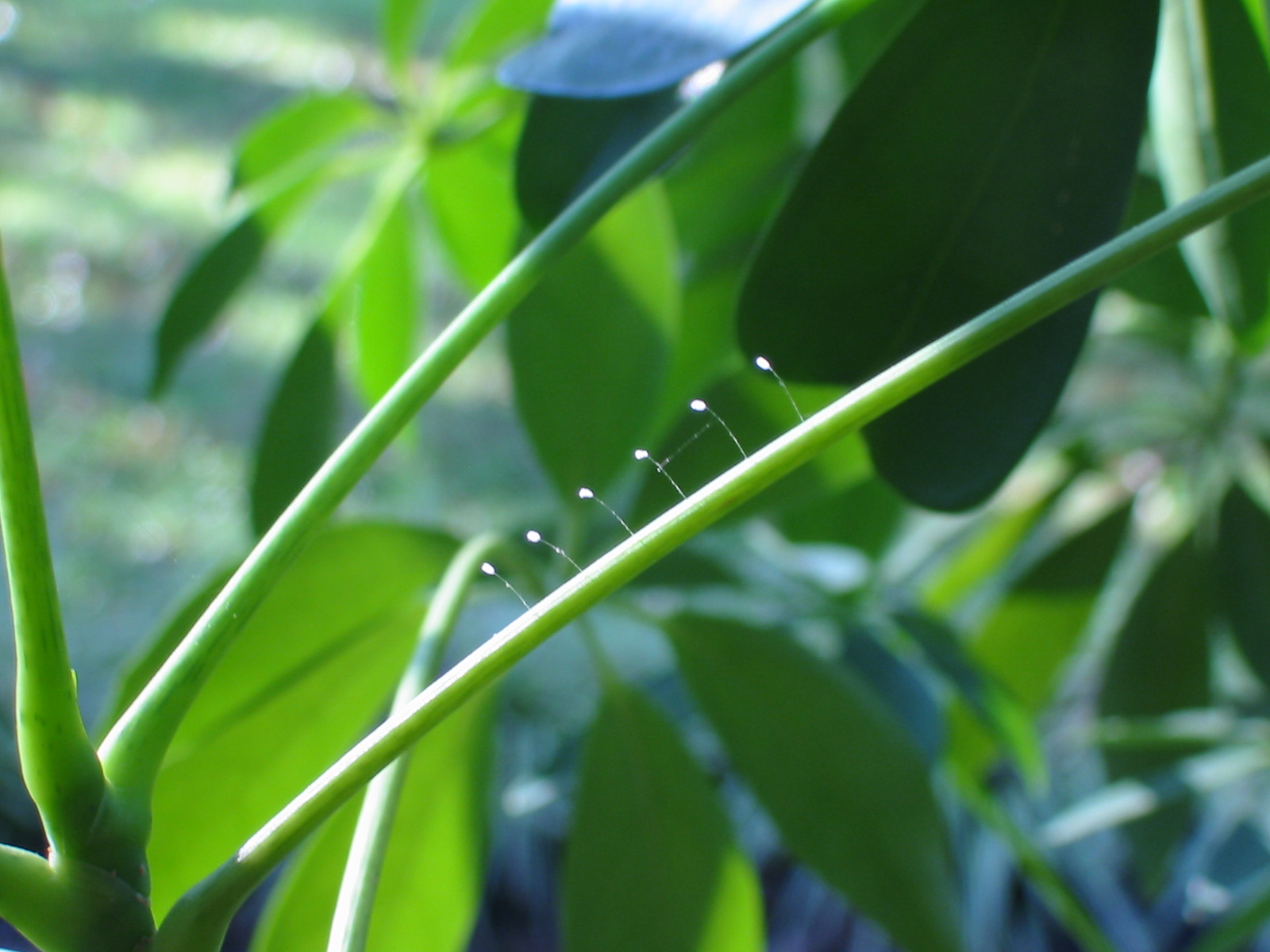
Green Lacewing Eggs
The miniscule space needles growing out of the shefflera stem above are not fungi.  They are the slim, stalked eggs of the green lacewing.  Lacewing eggs are usually laid on the undersides of leaves and stems.  They are a lovely surprise to find when working in the garden.  They seem so fragile that they would break or bend in the breeze, but you can brush your finger against them and they stand back up.  They are so delicate, that I can't feel them, even with my less calloused ring fingers.  They stand in peaceful beauty, glistening in the sun, while their infant lacewings develop inside each egg.  

Watch out, because after a few days, each egg cracks, and out charges a fierce, anxious monster of a teenage insect: the green lacewing larva.  It moves quickly and ranges widely, and it is hungry for fresh meat. It stalks, catches and eats every insect it can catch with its pointy mouth parts.  It kills its prey with toxic venom.  If it were 100 times larger, you would have to fortify your house and never go outside!  I'm certain some dangerous movie aliens are based on these ravenous killers. 

Scary green lacewing larva, source in picture.
After a few weeks, the green lacewing larva begins to feel full.  Its hunger for protein is sated.  It's ready to settle down, take up a peaceful existence and devote itself to future generations.  It finds a sheltered space under a leaf, wraps itself into a silk-bound ball, and metamorphoses into an adult.  The adult emerges, green and shimmering, and spreads its delicate, reticulated wings.  It floats off into the night, sipping nectar, mating and laying eggs.

Green lacewing adult with outstretched right forewing.
Don't fear the lacewing, even in its carnivorous stage.  It won't bite or sting you.  It will, however, remove hundreds of pest insects from your garden.  One lacewing larva can eat 200 aphids in a week!  Some organic gardeners buy and release lacewings onto their farms to help control insects.  Pesticides kill these useful farm workers, allowing pest insects to move back into the area with no predators.  Since pests can usually reproduce faster than prey, if both pests and prey are killed, you're likely to have a worse pest problem in a few weeks when the population recovers.  Encouraging beneficial insects like the green lacewing helps cut down on expenses, work and pesticide usage.  To encourage lacewings, plant flowers that the adults like, for example coreopsis, dill, Queen Anne's lace, cosmos and other similar plans.  You can also leave some of your dandelion weeds, because lacewings love them.

I apologize to my biologist readers for all the anthropomorphizing above, but these little critters seem very dramatic to me. 

Wednesday, August 31, 2011

Zombie Worms From Planet Sphinx

This time of year, when you're harvesting tomatoes, you often notice part of the plant where the leaves seem to be missing and all that's left are stubby stems.  This is not a deformed tomato plant.  Look closely and you will see a stem that seems to be especially thick and stubby like so: 

Tobacco Horn Worm (Source)
The gigantic worm above is a tobacco horn worm.  It is a positively ravenous caterpillar that literally stuffs itself with tomato or tobacco leaves.  If you touch one, it seems to be so full that its skin feels like a grape leaf around a dolma.  It eats so much of the tomato plant that it can reduce tomato productivity dramatically.  Farmers dislike these caterpillars, but I bet most of them also admire the strangeness of these creatures. 

Tobacco horn worms grow from tiny eggs deposited on tomato plants by the Carolina sphinx moth, a gorgeous night creature that moves and hovers like a hummingbird.  It has a coiled proboscis that it uses to probe nectar from night-blooming flowers trumpet-shaped flowers.  Here is a sphinx moth feeding on an azalea:

Sphinx moth feeding.  (Source)
 Sometimes when you see a tobacco horn worm, it will appear to be covered with dozens of white, ovoid bead-like objects.  When you see this, you know the horn worm is one of the walking dead.  The white things are the pupal cases of a type of braconid wasp, which lays its eggs under the skin of the horn worm.  The eggs hatch inside the horn worm and eat the worm from the inside out.  The larvae begin to burst out of their horn worm and weave little white cases with lids around themselves.  In a few days, they will emerge as adult wasps, and the horn worm will expire as a shrunken husk of itself.  The adult wasps will go on to infect and kill other horn worms.  Braconid wasps are friends of the farmer because they help do the work of dispensing with horn worms.  Anytime a farmer sees an infected horn worm, she lets it be so that more wasps will hatch.  Farmers can even order braconid wasps in the mail to release on their farms.  Here is an infected horn worm:

I know it's hard to see, but there is a parasitised tobacco horn worm in the middle of the picture.  I'll bring a better camera to work tomorrow.
 Here are some better pictures I didn't take from this website:

A good picture of an infected hornworm.

An adult braconid wasp spreading its wings for the first time.


Saturday, July 2, 2011

The Ladybug's Obnoxious Cousin

Everyone loved ladybugs as a child.  We picked them up; we counted their spots, and we may have even brought them inside.  The cute, round bugs are ubiquitous on children's books and clothes.  Ladybugs are some of our earliest friends, so it's surprising to find a pest dressed up like our little pals.

The Mexican bean beetle looks like a ladybug that has rolled in the dust.  It's coppery-brown but still covered in spots and half-dome-shaped.  These beetles are true ladybugs, and they are classified in the ladybug family, the Coccinellidae, which is a subset of the beetle order, the Coleoptera.  All my entomologist readers just cringed a bit after reading that last sentence (sorry!), since ladybugs are not actually bugs.  Entolomogists call them ladybird beetles.  I still use the term ladybug, because that's what I learned when I was 4 years old.  True bugs are in a different group of insects, Order Hemiptera, that includes stink bugs, aphids, leafhoppers and cicadas, but definitely not beetles.

Unlike almost all the other types of ladybugs, Mexican bean beetles are damaging to crops.  Ladybugs are generally famous for their ability to eat vast quantities of aphids and other pest insects.  But Mexican bean beetles are infamous for their herbivorous appetites.  The adult beetles are only moderate consumers of bean leaves, but after they lay their eggs, the larvae which emerge are voracious and insatiable.  Right now the larvae are out in full force.  Their little spiky orange bodies look like tiny Pokemon characters covering the bottoms of the leaves.  Every few days, as they grow, they slip out of their skin and leave it behind to grow a new one.  After a few weeks, they shed their skin and emerge as adult beetles.  Here is a spiky Mexican beetle larva along with some major leaf damage:


The Mexican bean beetle is currently helping itself to the snap beans on the farm, and it seems to show a slight preference for one of the two varieties we have.  They technically will eat any kind of bean plant, but snap beans and lima beans are their favorites.  Many of this season's bean plants have been reduced to lacy brown ghosts of themselves.  The plants are still are squeezing out a few green beans, but these poor plants are stressed to the max by their little inhabitants.

There are many strategies to dealing with Mexican bean beetles on an organic farm.  One strategy is to time the bean crops to minimize damage.  The beetles emerge every year around mid June.  They have overwintered as adults, hiding in warmer places or under debris, and the first adults to emerge are especially drawn to bean plants to lay eggs.  If you plant your bean crop early, you can harvest beans before the scourge begins.  Also, you can wait until the first round of adults emerges and flies somewhere else to look for beans and then plant your crop.  It is thought that eliminating probable overwintering locations can be helpful.  Beans in infested areas should be harvested quickly before the beetles can damage them. In addition, the larvae are susceptible to insecticidal soaps, which disrupts their cuticles and they desiccate. 

The farmer I work for is using a neat but gruesome approach to eliminating the Mexican bean beetles.  She and her son ordered wasps through the mail and released them into the bean field.  These wasps lay their eggs on Mexican bean beetle larvae.  The wasp eggs grow inside the larvae, eating its flesh, and then they emerge from the larvae as adult wasps that go on to lay their eggs on other unsuspecting beetle larvae.  As you might suspect, the larvae do not survive this process!  The parasitized larvae enlarge and turn orange-ish.  At this stage, they are referred to as mummies.  Here is a picture of a bean leaf with both yellow larvae and orange mummies:


The wasps' life cycles repeat in quick succession, and soon the larvae should be mostly mummified.  The bean plants will hopefully recover - even now, their newer growth looks healthy and robust.  Soon I'll be able to stop looking at every ladybug with a suspicious eye.

Here is your reward for making it to the end of this post:  All members of the ladybug family can secrete a noxious compound from their knee joints when they are irritated.  The compound is subtle to our noses, but you can smell it if you bother a ladybug and sniff its knees.  The scent from Mexican bean beetles is a little stronger.  This secretion is a deterrent to predators, who find it distasteful.